Coachful vs Kajabi: the full cost and workflow comparison
Kajabi is strongest when courses, funnels and email sell the business. Coachful is designed around the ongoing coaching relationship. Compare the actual plan bill, payment fees, client workflow and migration effort.
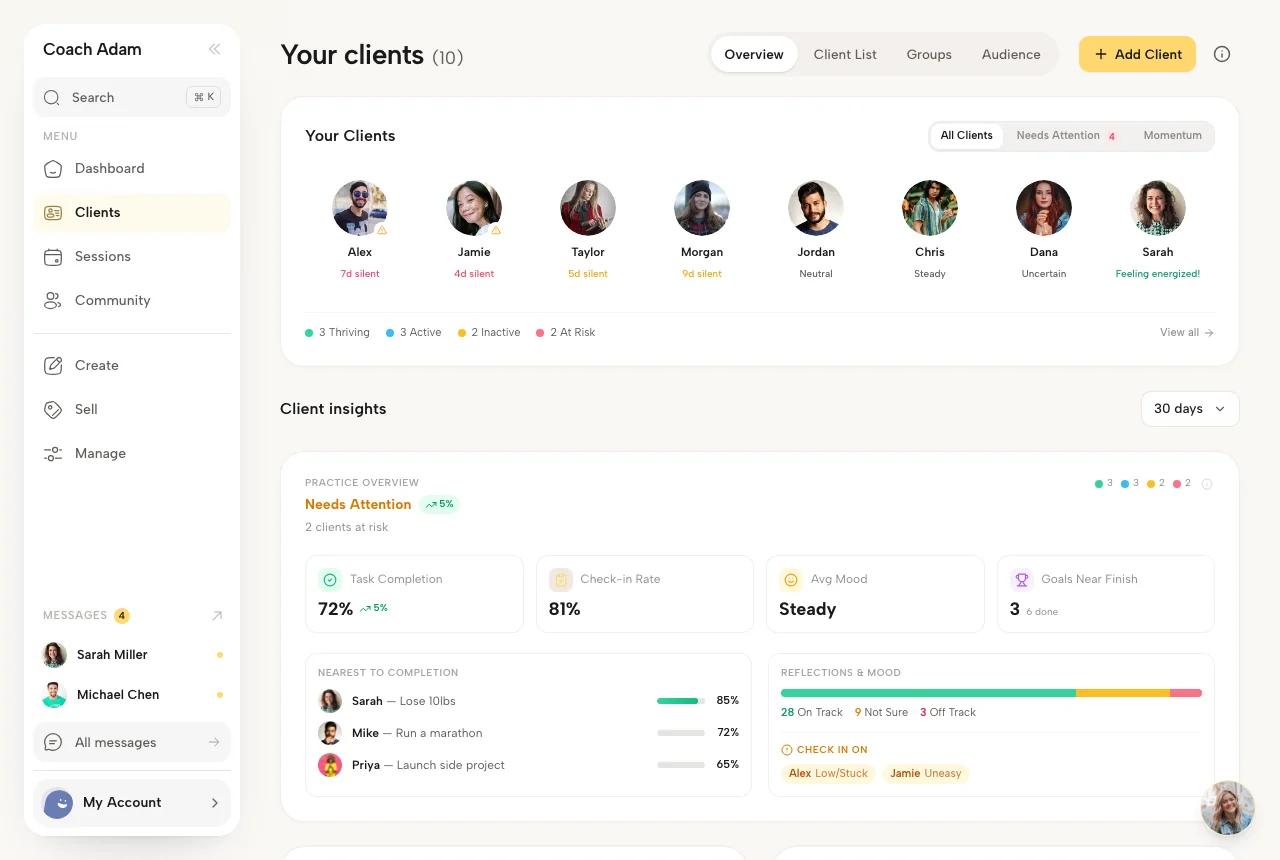
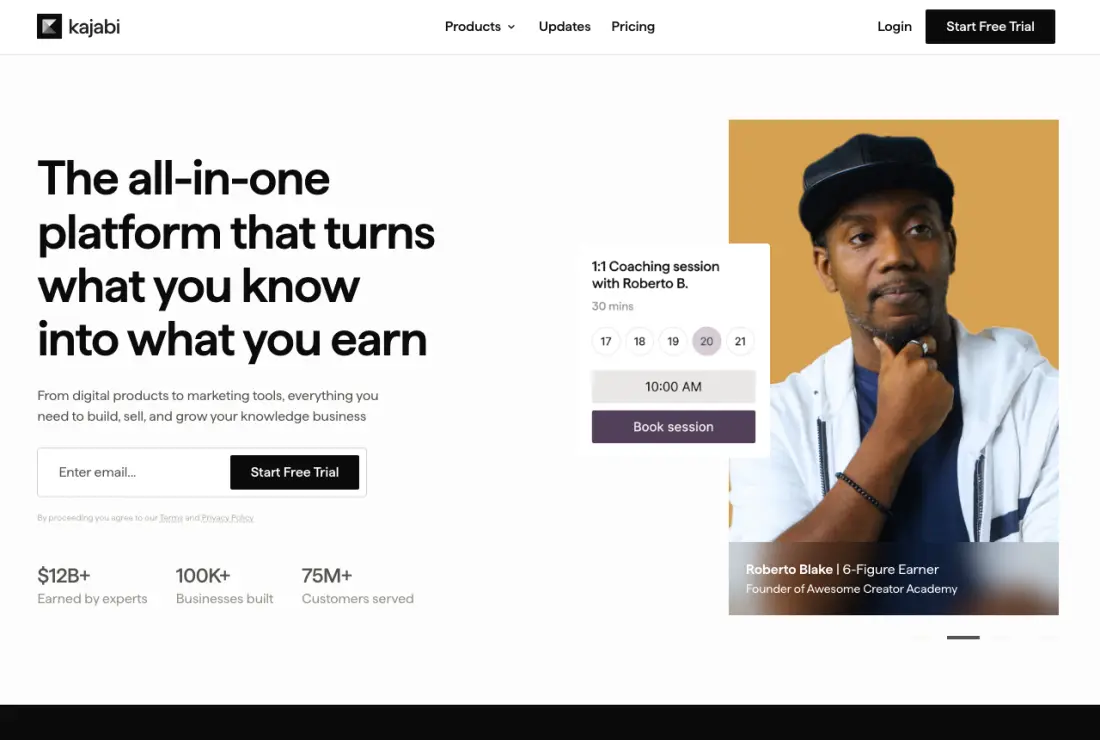
A course creator with coaching attached and a coach with courses attached can use many of the same features and still need different software. The first spends the day building a catalogue, funnels and an email list. The second spends it preparing sessions, following up, checking client work and renewing engagements.
Kajabi and Coachful overlap on courses, websites, funnels, email, payments, community and booking. This comparison is about where that overlap ends, what the plan actually costs, and which second subscription each business might still need.
Disclosure: Coach Platforms is published by Coachful. We make one of the products in this comparison. Kajabi has the stronger mature course and marketing ecosystem; the conclusion below is an editorial judgment from an interested publisher.
Prices and capabilities were checked against the vendors’ published pages on 23 September 2026.
The short answer
Kajabi is the stronger content commerce system. Coachful is the stronger fit for a coach whose main product is an ongoing client engagement. Kajabi Basic lists at $179 monthly or $1,716 paid annually; compare that bill with the Coachful price assigned to your account and any other tools you would keep.
Kajabi plans and the invoice you actually pay
These are US-dollar list prices from Kajabi’s pricing page. The annual column is the full annual charge, not a month-to-month option. Taxes and card processing are additional.
| Kajabi plan | Monthly billing | Annual invoice | Main capacity |
|---|---|---|---|
| Basic | $179/mo ($2,148/yr) | $1,716 ($143/mo equivalent) | 5 products; 2,500 contacts |
| Growth | $249/mo ($2,988/yr) | $2,388 ($199/mo equivalent) | 50 products; 25,000 contacts |
| Pro | $499/mo ($5,988/yr) | $4,788 ($399/mo equivalent) | Unlimited products; 100,000 contacts |
Annual billing saves $432, $600 or $1,200 respectively against twelve month-to-month payments. The savings require paying the year up front.
The payment fee that changes the comparison
Kajabi publishes US Kajabi Payments card rates of 2.9% + $0.30 on Basic, 2.8% + $0.30 on Growth and 2.7% + $0.30 on Pro. These are processing fees, not a platform revenue share. Its pricing page also lists an additional 2%, 1% or 0.5% fee by tier for an eligible third-party provider, explicitly excluding PayPal.
Kajabi says that surcharge does not apply where Kajabi Payments is unavailable. Read the country and processor caveats before modelling your own fees.
At $5,000 of monthly sales, a 2% additional provider fee would be $100 a month, or $1,200 a year, on top of the chosen processor’s fees and the Basic subscription. That is an arithmetic scenario, not a universal Kajabi bill. Coachful states a 0% platform fee and routes payments through your own processor; processor fees still apply.
Coachful’s public plan page describes the current offer; an existing customer should use their account’s assigned price.
What each product is built to optimize
Kajabi is stronger when
- Recorded courses, memberships and digital products are the main revenue line.
- A large email list, advanced marketing automation and multiple funnels drive sales.
- You need Kajabi’s mature creator ecosystem and course-first customer journey.
Coachful is stronger when
- Clients buy a live engagement with sessions and work between sessions.
- Habits, check-ins, goals and coaching agreements belong on the client record.
- Your team needs one place to run scheduling, delivery and client follow-up.
Walk one client through both systems
Imagine a twelve-week engagement sold from a landing page. A lead submits a form, buys a package, signs an agreement, books a first call, receives a lesson each week and records a daily habit. Both platforms can handle the page, checkout and course content.
Kajabi’s Coaching product also includes a scheduler and live video, so the first call is a real Kajabi workflow rather than a workaround.
The difference appears after the call. Kajabi can record coaching sessions and milestones. Its public feature list does not document a native e-signature agreement or a daily habit and check-in workflow, so verify those steps in a trial if they matter to you.
Coachful models the whole engagement around a client, with tasks, habits, check-ins, goals, sessions and an e-signed agreement. If most buyers consume lessons without personal coaching, Kajabi’s structure is more natural.
What a twelve-month decision should include
Start with the plan that fits your real contact and product counts, not the lowest advertised tier. Add payment processing, any third-party provider surcharge that applies to your country and processor, the scheduler or contract tool you still need, and the cost of moving a catalogue. A $143 monthly-equivalent annual Kajabi Basic plan is a $1,716 commitment before those extras.
For Coachful, use the price actually assigned to your account. A static blog cannot know whether you have an older protected price. Include the price of any specialist email or course tool you would retain.
If you already have a paid Kajabi year, finishing that term while you move coaching delivery can be cheaper than trying to replace everything in a weekend.
How to decide in a trial
Build the same offer
Create one sales page, one payment option, one onboarding form and one session booking on each platform.
Complete a client week
From the client account, open a lesson, submit the between-session work, message the coach and book the next call.
Count the remaining tools
List every paid product you still need and price the next twelve months using the real billing period and your own payment volume.
Check exit costs
Export contacts and content samples before committing. Rebuilding email automations and course layouts is work even when the new subscription is cheaper.
Common questions
Is Kajabi cheaper when billed annually?
Yes. Basic is $1,716 for a year, equivalent to $143 a month, versus $179 month-to-month. Growth is $2,388 annually and Pro is $4,788. The annual price requires paying the year up front.
Does Kajabi have coaching sessions?
Yes. Its Coaching product includes scheduling and live video. The main difference is in the work around sessions: Coachful provides native habits, check-ins, client tasks and agreements; verify any equivalent Kajabi workflow in a trial.
Does Kajabi take a percentage of sales?
Kajabi says it has no platform revenue share when you use Kajabi Payments, but card processing applies. An additional provider fee of 2%, 1% or 0.5% can apply by tier when using an eligible third-party provider where Kajabi Payments is offered; its pricing page excludes PayPal from that listed fee.
Which platform is better for courses?
Kajabi is the better fit for a course-first business with a large list and a mature marketing operation. Coachful supports courses, but its centre of gravity is the ongoing coaching engagement.
What Coachful price should I use?
Use the amount assigned to your own account or shown in your own checkout. Existing pricing assignments are preserved, so a static comparison cannot safely quote one Coachful price for everyone.
The verdict
Choose Kajabi when the catalogue and the email funnel are the business and personal coaching is one offer inside it. Choose Coachful when the engagement is the product and lessons support live client work. In either case, calculate the full year and complete one client journey before buying.
Primary price source
Kajabi’s published Basic plan is $179 per month. Read Kajabi’s current pricing before buying. Your Coachful amount depends on your account’s preserved pricing assignment and is shown in your own checkout or plan settings.