Most CRMs are built around a sale. A contact enters a pipeline, moves through stages, and either converts or does not — at which point the record has essentially done its job.
Coaching inverts that. The sale is the beginning of the record’s useful life, and what matters is everything that accumulates afterwards: sessions, notes, progress, payments, renewals, and a relationship that may run for years across several engagements.
The criterion here is that distinction. Does the client record hold the coaching work, or does it hold the deal and stop?
The short answer
Ranked by whether the client record holds the coaching work rather than just the deal, Coachful is first from $29 a month and we make it, with Dubsado at $40 and HoneyBook at $36 both stronger as general CRMs. A sales CRM tracks a person until they buy; a coaching record has to keep accumulating for years afterwards.
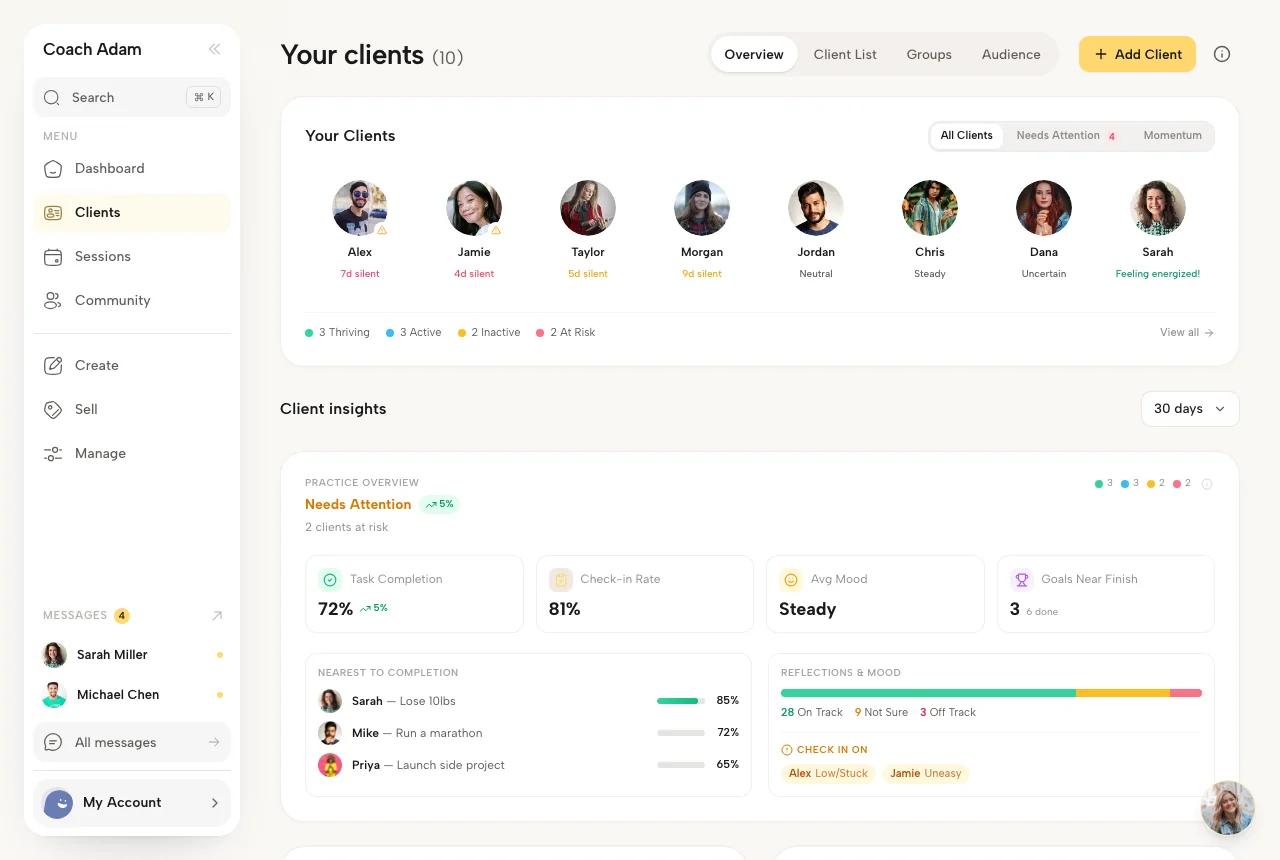
HoneyBook home page · captured 22–23 September 2026
4. CoachAccountable
CoachAccountable home page · captured 22–23 September 2026
Every tool, in detail
1
Coachful
from $29/mo
Coachful holds session history, programme progress, payment position, agreements and renewals on one client record that accumulates across engagements.
On pipeline and proposal tooling we are behind Dubsado and HoneyBook, and the criterion here is deliberately about the other half of the relationship.
Coachful client workspace · captured 22–23 September 2026
Best for
Coaches whose client relationships run for years across several engagements.
Where it falls down
Weaker pipeline and proposal tooling than the two dedicated CRMs here.
2
Dubsado
$20–40/mo
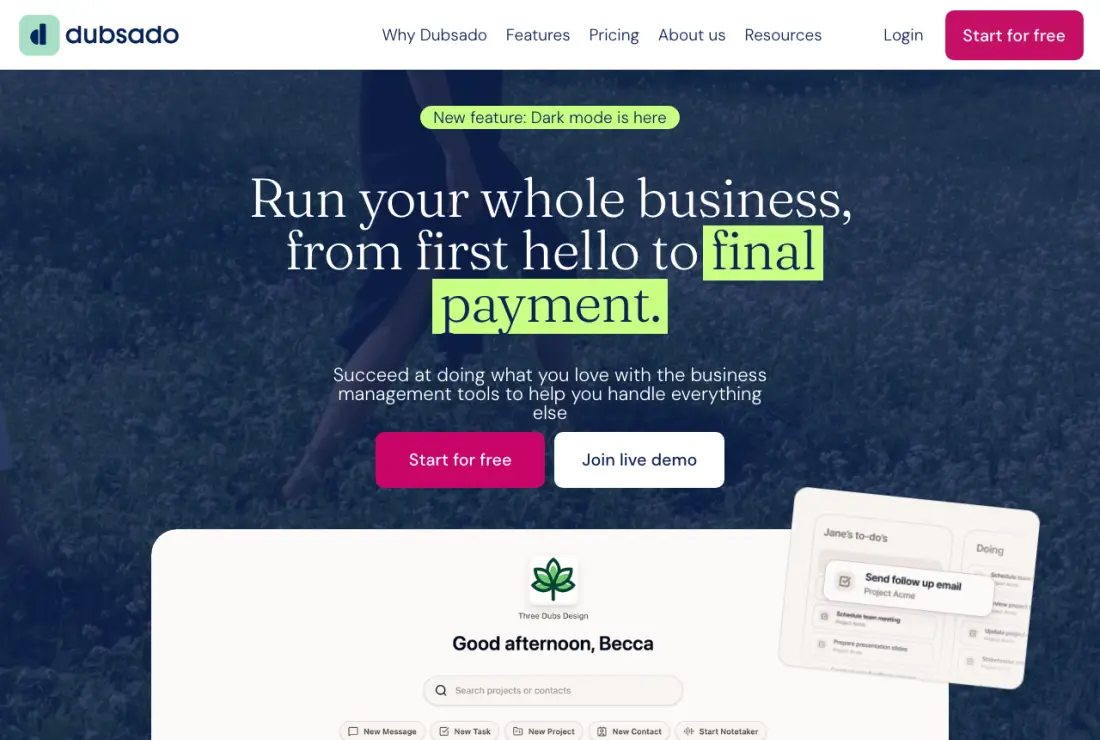
Dubsado has the strongest pipeline, proposal and workflow tooling in this comparison, with conditional automation nothing else here matches.
It models a project. Session history, programme progress and renewals on a coaching relationship are not structures it has, so they live in notes.
Dubsado home page · captured 22–23 September 2026
Best for
Coaches whose hard part is the sale and the onboarding around it.
Where it falls down
Deal-shaped, so coaching history becomes notes fields.
3
HoneyBook
$36–129/mo
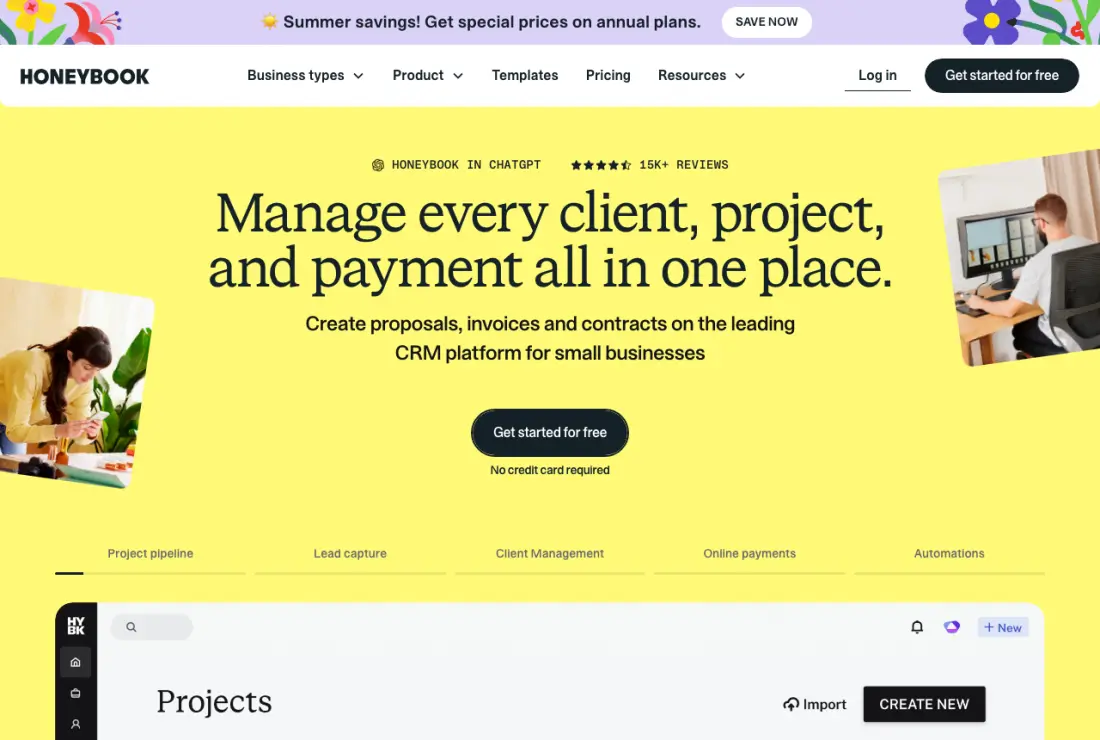
HoneyBook is an excellent service-business CRM: pipeline, contracts, invoices and proposals in one, at $36.
Like Dubsado it is deal-shaped, so the record is most useful up to the point of sale and least useful during the eighteen months afterwards.
HoneyBook home page · captured 22–23 September 2026
Best for
Mixed service practices wanting one commercial record across everything.
Where it falls down
Same project-shaped limitation, with less workflow depth than Dubsado.
4
CoachAccountable
$20–100/mo (by client count)
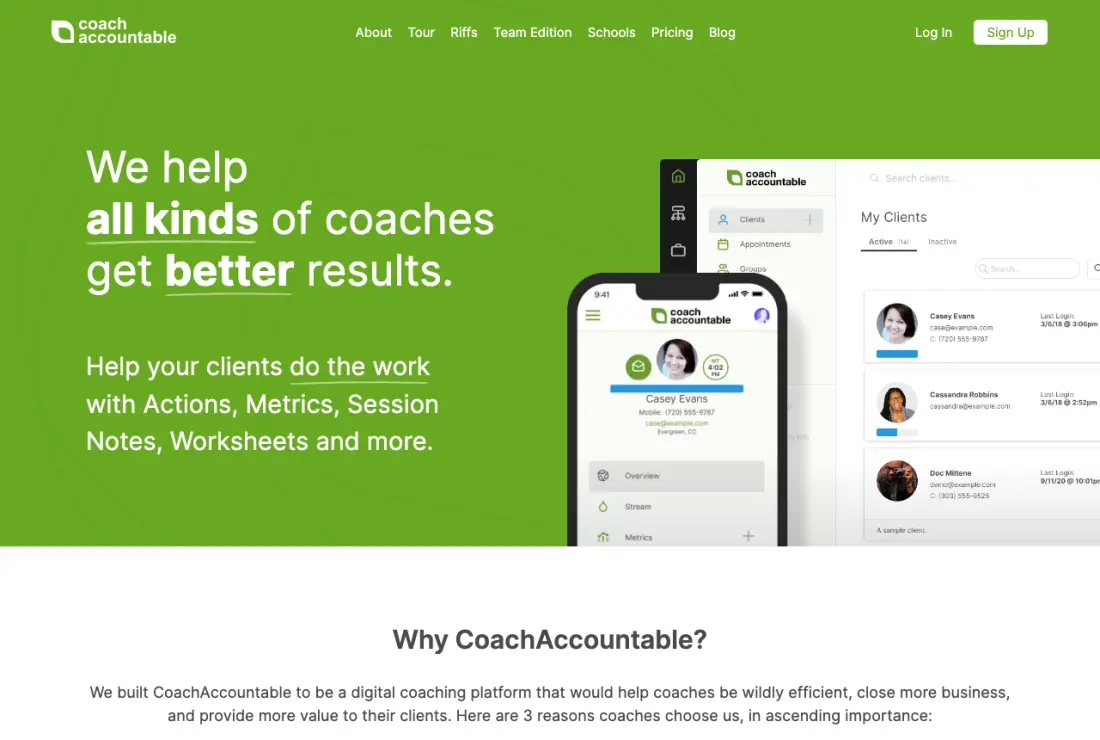
CoachAccountable holds the coaching work better than any dedicated CRM here: sessions, actions, metrics and worksheets accumulating over years.
It has no pipeline, so the pre-sale half is not modelled at all, and there is no website. It solves the opposite half from HoneyBook and Dubsado.
CoachAccountable home page · captured 22–23 September 2026
Best for
Coaches whose record needs to hold years of between-session work.
Where it falls down
No pipeline and no website; it solves only the post-sale half.
5
Simply.Coach
$9–69/mo (by client cap)
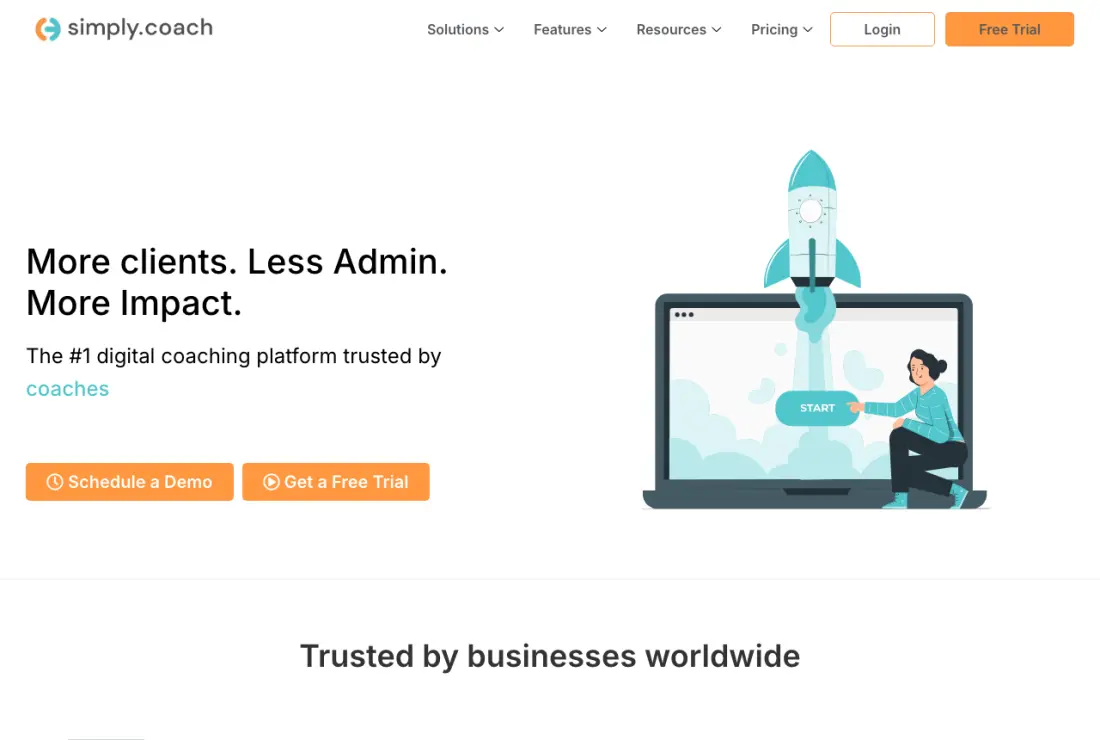
Simply.Coach keeps a coaching-shaped client record with programmes, goals and engagement history, plus partial pipeline handling at $29.
No public website, so acquisition stays a separate subscription even though the record itself is right.
Simply.Coach home page · captured 22–23 September 2026
Best for
Coaches who want a coaching-shaped record with some pipeline handling.
Where it falls down
No website, so acquisition is a separate subscription.
6
CoachVantage
$39–59/mo
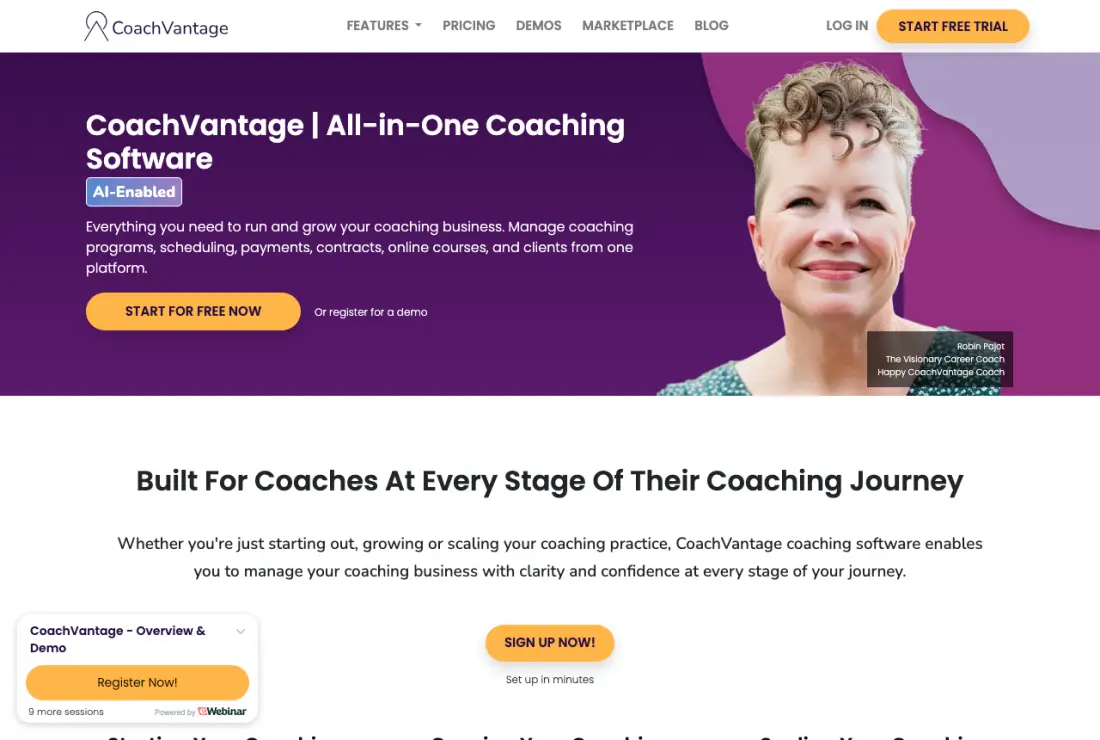
CoachVantage keeps client records tied to enrolments, contracts and payments in a coaching-native product.
Programme progress is lighter, so the record holds the commercial history more completely than the coaching work.
CoachVantage home page · captured 22–23 September 2026
Best for
Coaches whose record mainly needs to hold enrolments and payments.
Where it falls down
Lighter programme progress in the record.
What a coaching record has to carry
Session history. Every session, with notes, across every engagement. A client returning after eighteen months should arrive with their context intact rather than as a new contact.
Programme progress. Where they are, what they have completed, what they have stopped doing.
The money. Which package, how much of it is paid, when the next instalment collects, when the renewal is due.
The agreement. What was actually signed, one click away rather than in an inbox.
A sales CRM supplies contact details, a pipeline stage and a deal value. All four of the above become notes fields, and notes fields are where coaching records go to die.
Deal-shaped against coaching-shaped
Product
Price
Pipeline
Session history
Programme progress
Renewals
Coachfulours
from $29
Yes
Yes
Yes
Yes
Dubsado
$40
Best here
No
No
No
HoneyBook
$36
Best here
No
No
No
CoachAccountable
$20–$100
No
Yes
Best here
Partial
Simply.Coach
$29
Partial
Yes
Yes
Yes
CoachVantage
$39
Partial
Yes
Lighter
Partial
Comparison registry, verified May 2026. Dubsado and HoneyBook are genuinely better CRMs; they are built around a deal rather than an engagement.
Photo by Ofspace LLC, Culture on PexelsA sales CRM finishes its job when the deal closes. A coaching record starts its job there.
Why coaching records outlive sales records
A sales CRM is optimised for a funnel with an end. Contact enters, moves through stages, converts or does not, and the record has done its job either way.
Coaching records are the opposite shape. The sale is the start, and the useful life of the record is the years afterwards: several engagements, gaps between them, a referral they made, the thing they were working on in 2024 that has come back.
The practical consequence is a returning client. They are the cheapest revenue available to any coaching practice, and a deal-shaped record means they arrive as a stranger you have to re-interview, which is both worse coaching and a worse experience for them.
What a coaching record should still tell you in three years
Every engagement they have had, including the gaps, because a client who worked with you in 2024 and returns in 2027 is a different conversation from a new enquiry.
What they were actually working on, in enough detail to pick up rather than re-interview. Not a transcript — a thread.
Why each engagement ended. Completed, paused, outgrown, or quietly lapsed. That single field changes how you approach them.
Who they referred. The cheapest channel in coaching, and almost nobody records it, which means nobody closes the loop and the referrer never refers again.
What they paid, and whether anything was left outstanding. Rare, awkward, and much worse to discover mid-conversation.
Common questions
What is the best CRM for coaches?
Against a record that holds the coaching work rather than the deal, Coachful from $29 a month and we make it. Dubsado at $40 and HoneyBook at $36 are better general CRMs and model a project rather than a coaching engagement.
Can I use a normal CRM for coaching?
For the sale, yes, and several are better at it than coaching platforms. After the sale, session history, programme progress and renewals all become notes fields, which is where coaching records stop being useful.
What should a coaching client record contain?
Session history with notes across every engagement, programme progress, the payment position including the next instalment, and the signed agreement. All four one click from the same place.
Why does long-term client history matter?
Because returning clients are the cheapest revenue in coaching. A former client who comes back after eighteen months should arrive with their context intact rather than as a stranger you have to re-interview.
Is Dubsado or HoneyBook better than a coaching platform?
As a CRM, yes — both have stronger pipelines, proposals and contracts. They model a deal or a project, so everything that happens during a coaching engagement sits in notes rather than in structure.
Do coaches need a CRM?
They need a client record, which is a different thing. A sales CRM tracks a person until they buy; a coaching record has to keep accumulating sessions, progress, payments and history for years afterwards.
Why do returning clients matter so much?
They are the cheapest revenue in coaching — no acquisition cost, no objections, already know how you work. A record that stopped at the sale means each one arrives as a stranger and the advantage is lost.
What should a coaching client record still show in three years?
Every engagement including the gaps, what they were working on, why each one ended, who they referred, and what they paid. A record that stops at the sale means a returning client arrives as a stranger.
The verdict
Dubsado and HoneyBook are better CRMs than we are and it would be silly to claim otherwise. For a practice whose hard part is the sale — proposals, pipeline, multi-stage onboarding — either is a strong answer.
Coachful wins this criterion because coaching’s hard part is usually after the sale, and a record that stops at the deal loses exactly the history that makes a returning client easy. Run the eighteen-month test on whatever you currently use; the answer is usually clarifying.
How to disagree with this
The criterion is the whole argument. If breadth is not what you need, this order is irrelevant to you and a different list will serve you better. That is why there are several, each ordered by something different.
For a version of the same products with no ordering at all, the alphabetical directory lists every one of them and picks nothing.
Published by Coachful, which makes one of the products ranked here. No affiliate links and no paid placement.