This directory ranks by one measurable thing at a time. Here it is stack coverage: how many of the eleven parts a coaching business needs are shipped by the product itself rather than bought separately.
That is a count rather than a judgement, which is the point. A product either ships scheduling or it does not, and the registry records partial coverage as partial rather than rounding it up.
It is also a criterion that favours breadth, and breadth is not the same as quality. Three products below are better than ours at the specific thing they concentrate on, and each entry says which thing.
The short answer
Ranked by how many of the eleven parts of a coaching stack each product ships, Coachful is first and we make it. Kajabi covers the content half comprehensively at $179 a month, GoHighLevel covers the marketing half at $97, and CoachAccountable covers the coaching half at $20 with no website or commerce layer.
Breadth of the coaching stack covered by one subscription
A coaching business needs the same eleven jobs done. Every one a tool does not cover is a second subscription and a second place your client data lives.
GoHighLevel home page · captured 22–23 September 2026
4. Systeme.io
Systeme.io home page · captured 22–23 September 2026
Every tool, in detail
1
Coachful
from $29/mo
Coachful ships all eleven parts, which is what puts it first against this criterion and nothing else. We publish this directory and chose the criterion, and both of those facts should be weighed.
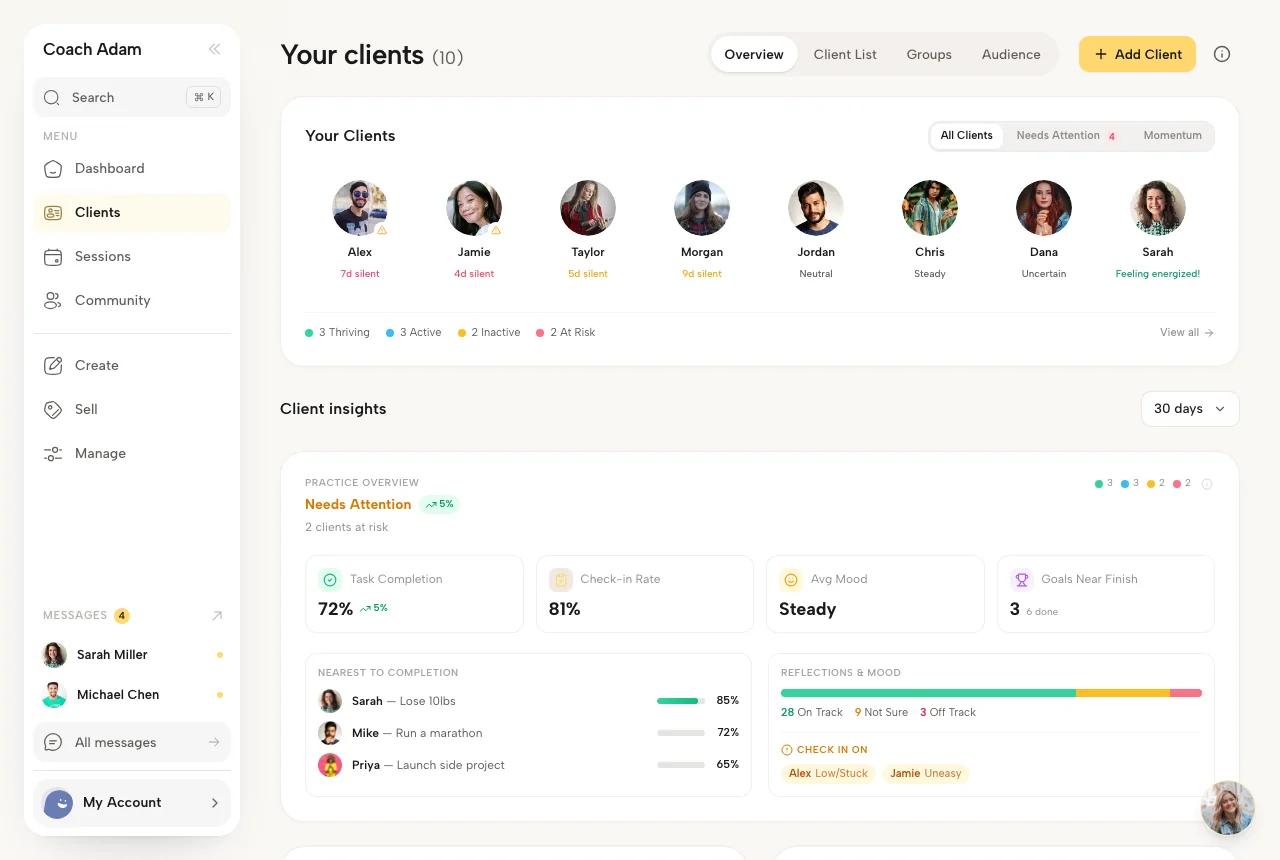
The practical consequence of full coverage is that the client record is one object. A person who booked a session, bought a package on instalments, joined a cohort and is halfway through a programme is one record rather than five, which is the difference the coordination hours actually come from.
Coachful client workspace · captured 22–23 September 2026
Best for
Coaches who would otherwise buy one coaching-shaped, one content-shaped and one marketing-shaped product.
Where it falls down
Nothing this broad is the deepest tool in any one category, and three products here beat us at what they concentrate on.
2
Kajabi
$179–499/mo ($143–399 annual)
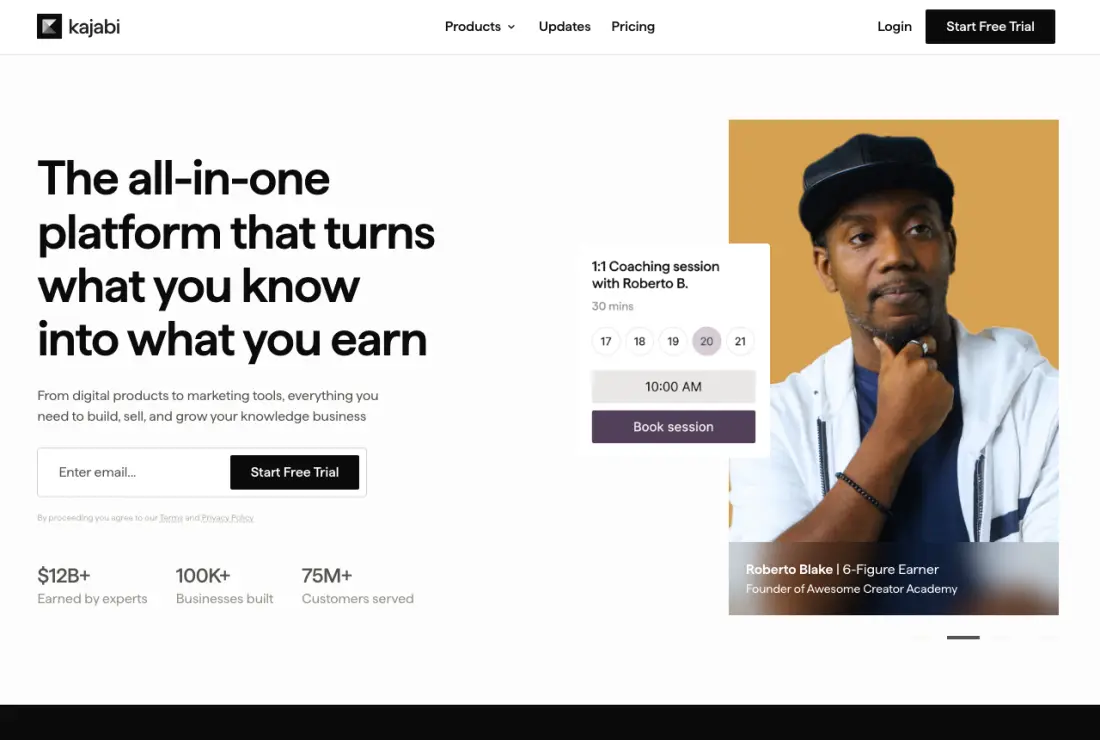
Kajabi covers the content half of the stack more completely than anything else here and is better than us at all of it: courses, checkout, funnels, email and pages.
The registry records coaching programmes as partial, which is accurate rather than dismissive. Kajabi models a purchase granting access, not an engagement with sessions, progress and a renewal date, so a coaching relationship runs alongside it rather than inside it.
Kajabi home page · captured 22–23 September 2026
Best for
Businesses where the content is the product and coaching is a premium line alongside it.
Where it falls down
Coaching programmes are partial and there is no scheduling, so the ongoing relationship lives in a second product.
3
GoHighLevel
$97–497/mo + metered usage
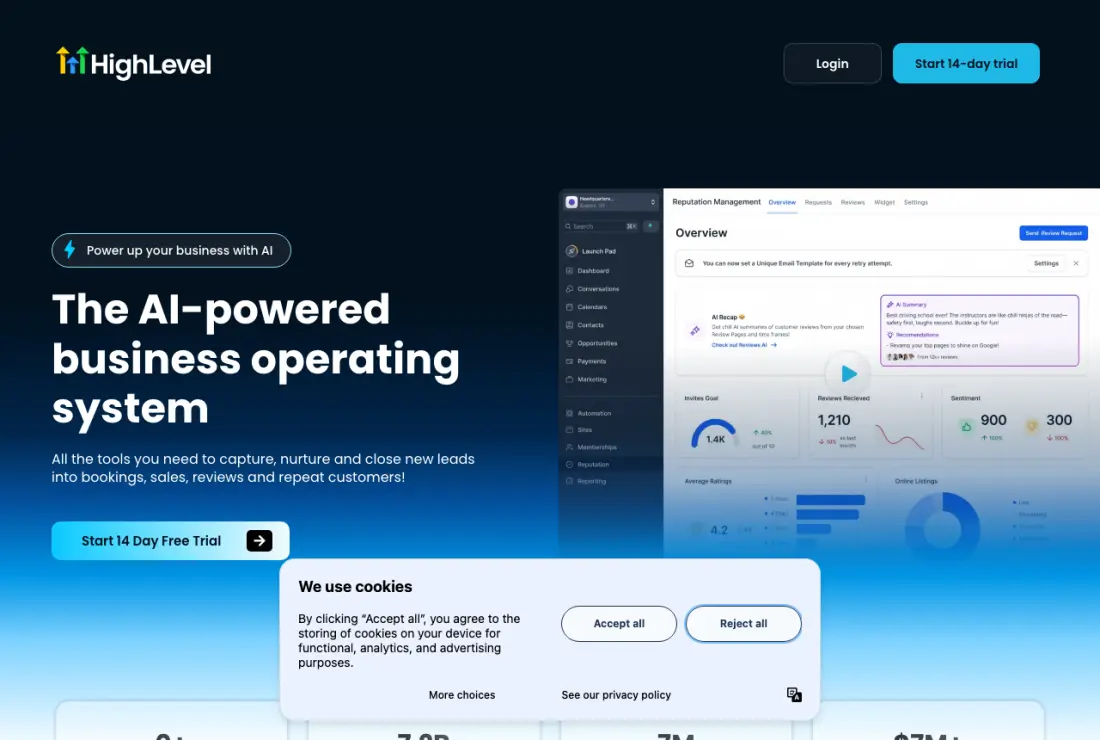
GoHighLevel covers marketing more comprehensively than any other product on this page: funnels, pipelines, multi-channel automation, sub-accounts and white labelling.
It has no coaching layer at all, which is a design decision rather than a gap — it is built for agencies. A coach buying it gets an excellent marketing system and still needs somewhere for the coaching to live.
GoHighLevel home page · captured 22–23 September 2026
Best for
Agencies and coaches running genuine multi-step marketing operations across several brands.
Where it falls down
No coaching layer whatsoever, and a configuration cost measured in weeks rather than an afternoon.
4
Systeme.io
Free, then $17–97/mo
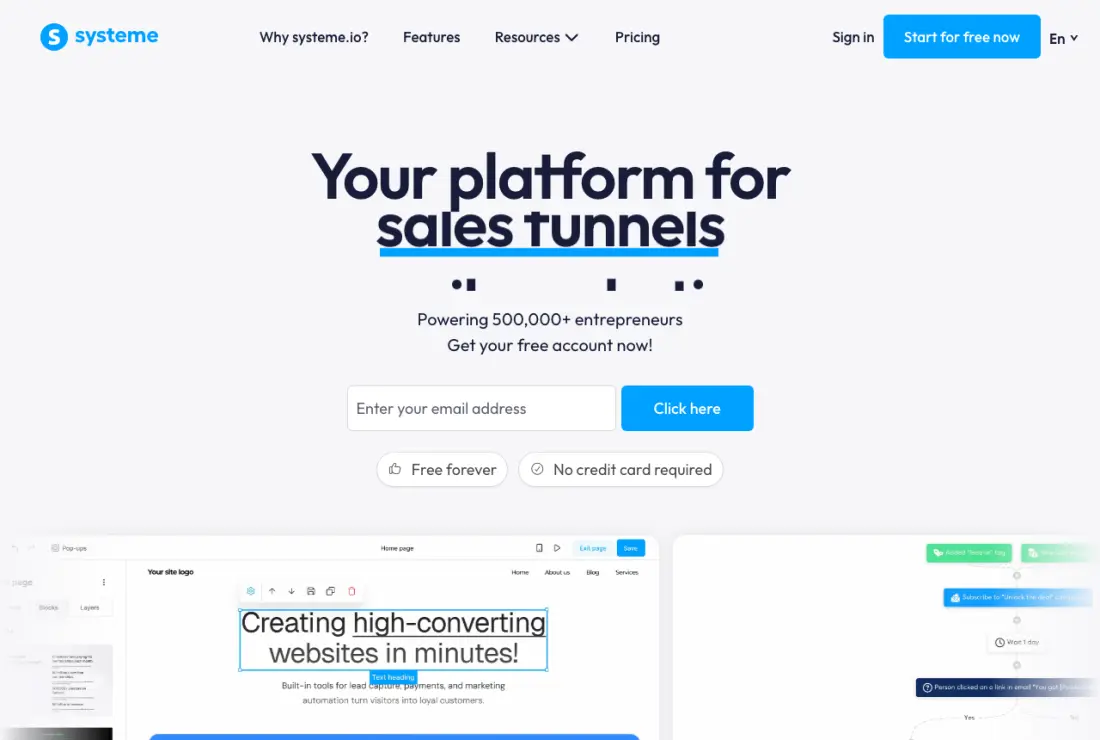
Systeme.io is the cheapest broad product here at $27 a month and covers funnels, email and course hosting in one subscription.
It has no coaching-specific layer, so scheduling, contracts, client records and programmes all remain separate. On coverage per dollar it performs very well; on coaching coverage it does not appear at all.
Systeme.io home page · captured 22–23 September 2026
Best for
Coaches on a tight budget whose immediate problem is selling something through a funnel.
Where it falls down
No coaching layer, so the entire practice side of the stack survives intact.
5
Mighty Networks
$95–215/mo + 1–2% of sales
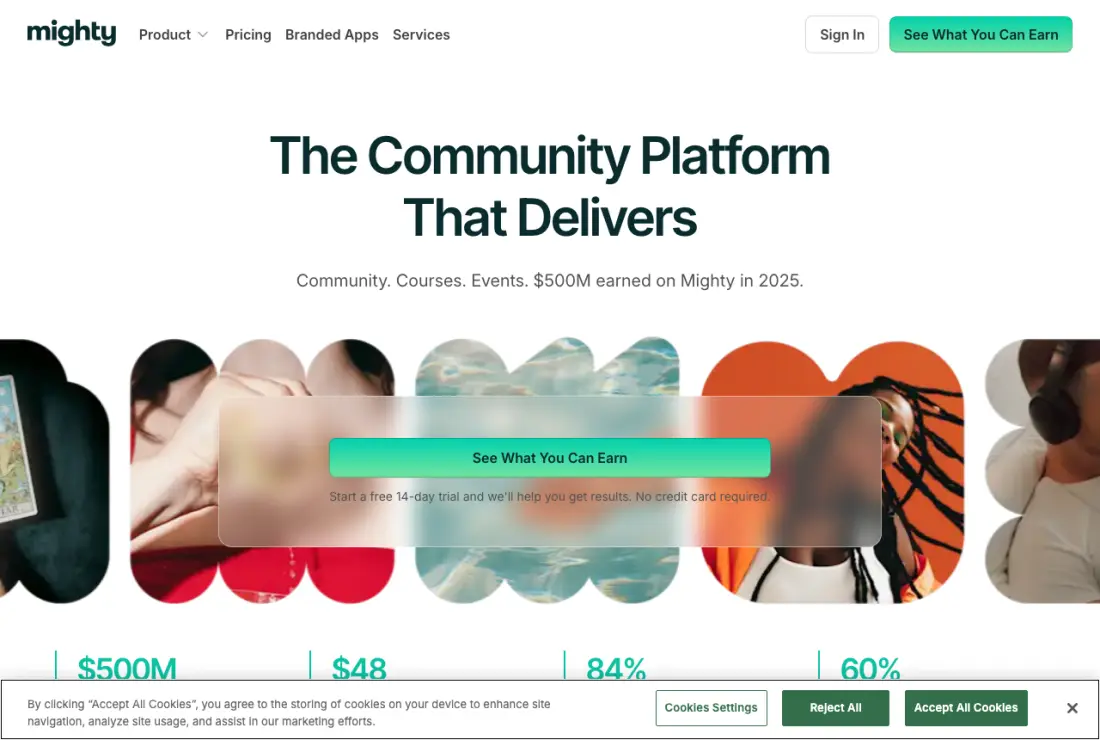
Mighty Networks covers community and cohort courses tightly together, with a branded mobile app that is better than most client portals on this page.
It ships no scheduling and records coaching programmes as partial, which places it firmly in the group-delivery half of the stack rather than the one-to-one half.
Mighty Networks home page · captured 22–23 September 2026
Best for
Group-led practices where cohorts and community are the delivery model.
Where it falls down
No scheduling and partial coaching programmes, so one-to-one work is elsewhere.
6
Skool & Circle
$49–99/mo
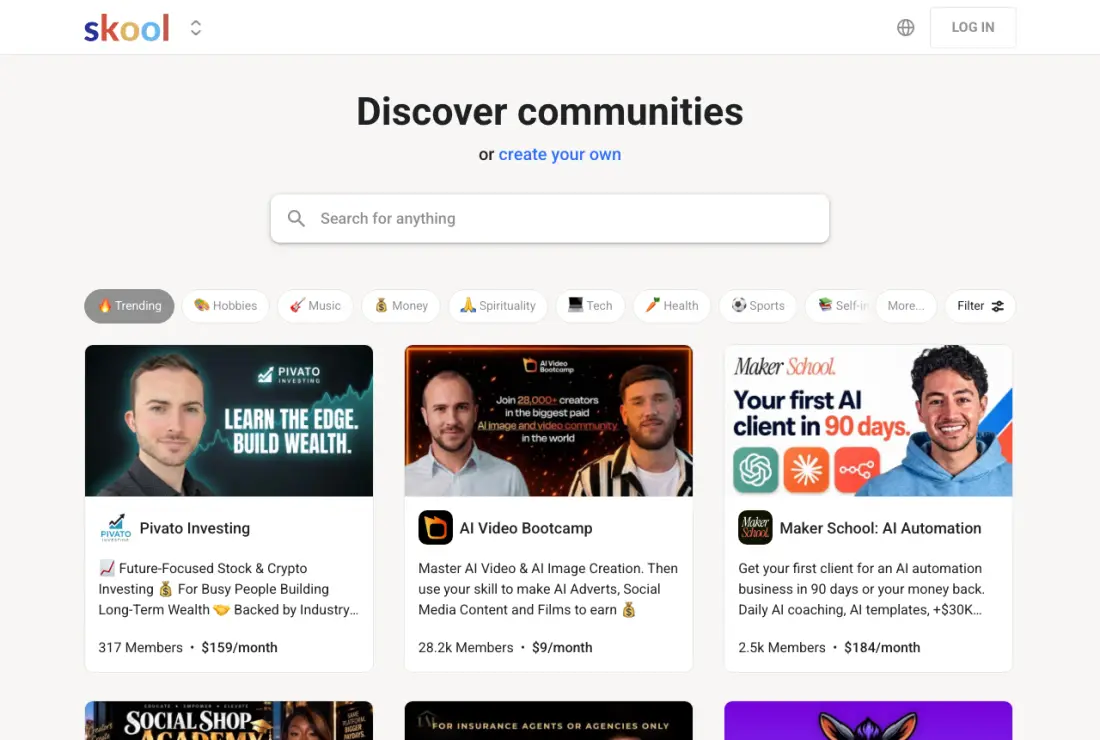
Skool and Circle cover community and nothing else on this list, which is why they sit low on a coverage count and high on the community ranking.
They are the best community products in this comparison. The registry records no coaching programmes, no in-app video and no calendar sync, so eight of the eleven parts are absent by design rather than by omission.
Skool & Circle home page · captured 22–23 September 2026
Best for
Businesses where a paid community is the product rather than a delivery format.
Where it falls down
Eight of eleven parts absent, at $99 a month.
7
Thinkific
$49–199/mo, 0% platform fee
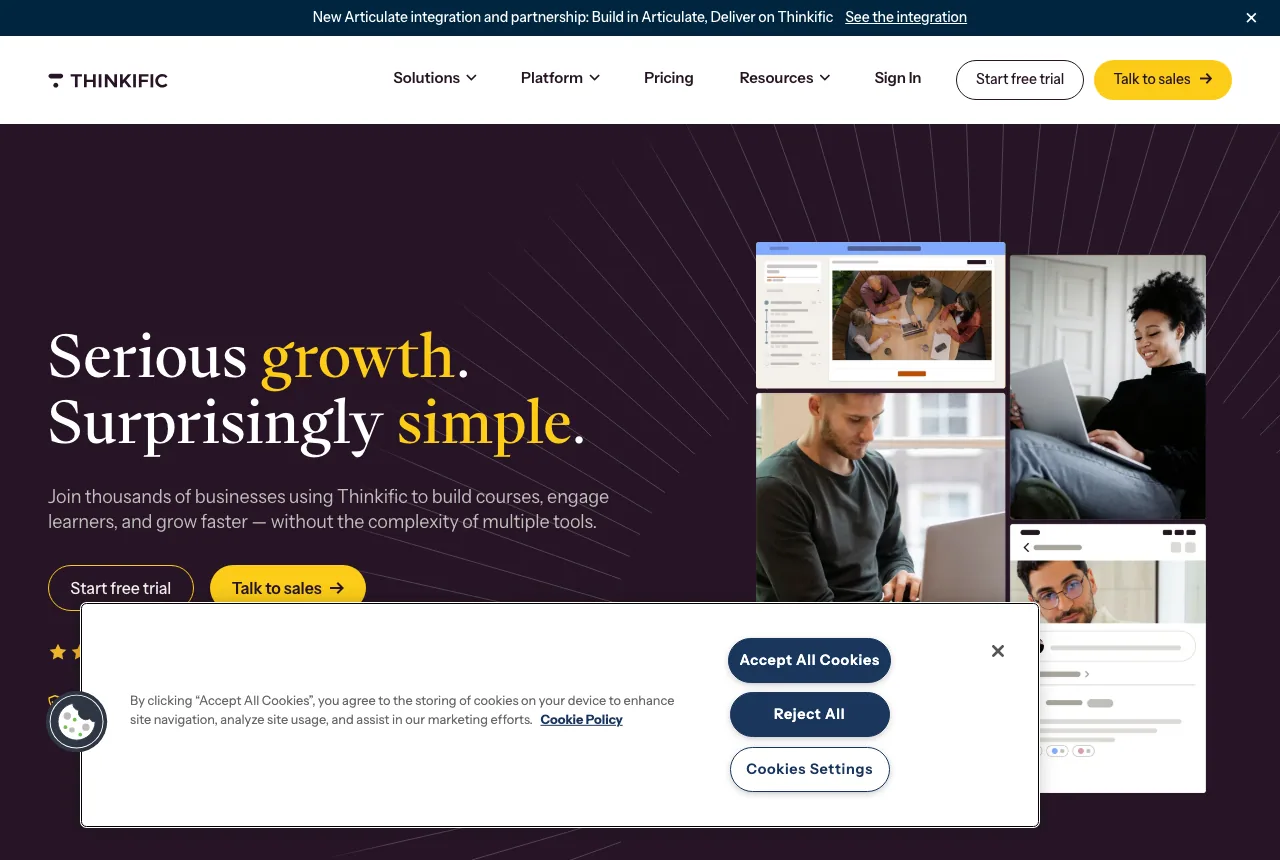
Thinkific covers course delivery, community and checkout — the content cluster — competently and at $49, which is half what Kajabi charges for a deeper version of the same shape.
Video and coaching programmes are recorded as partial, and there is no scheduling or contracts layer, so a coaching practice runs alongside it.
Thinkific home page · captured 22–23 September 2026
Best for
Course-led businesses that want the content cluster without funnel complexity.
Where it falls down
Partial video and coaching programmes; no scheduling or contracts.
8
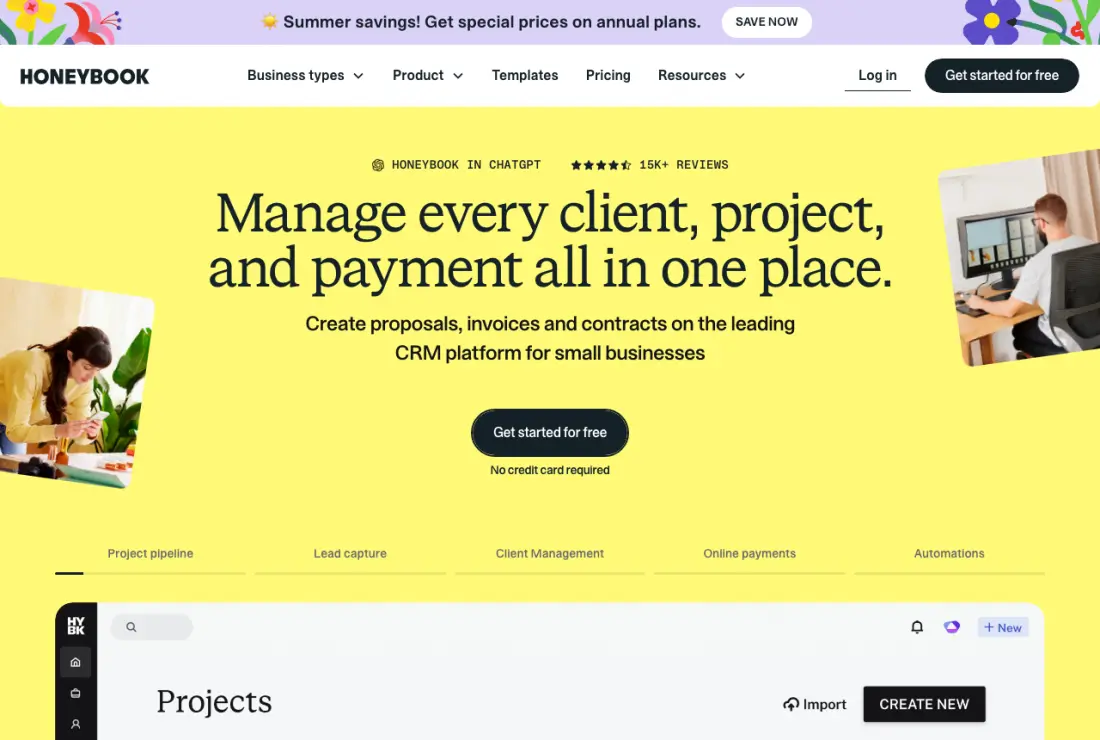
HoneyBook
$36–129/mo
HoneyBook covers the commercial parts thoroughly: contracts, invoicing, payment schedules and pipeline, at $36 a month.
It ships none of the coaching parts — no programmes, no session structure, no progress — because it is built for service businesses generally. On a coaching-stack count that is a low score and a fair description.
HoneyBook home page · captured 22–23 September 2026
Best for
Mixed service practices where the commercial paperwork is the hard part.
Where it falls down
None of the coaching parts, so delivery runs in a second system.
9
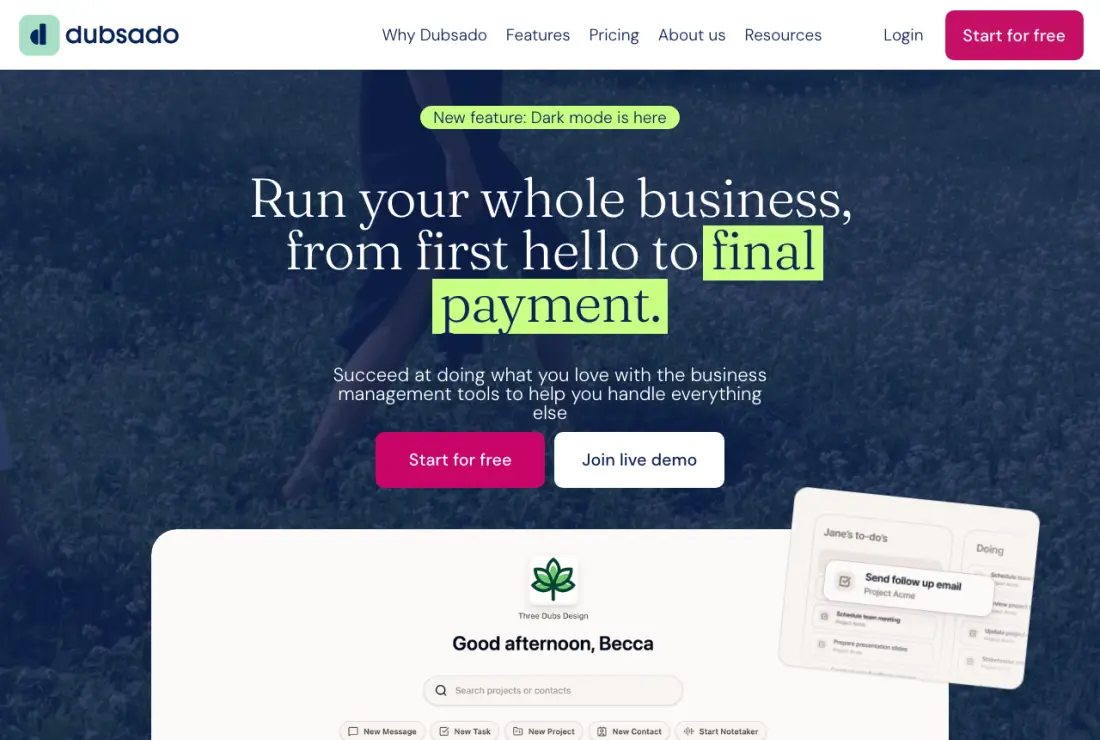
Dubsado
$20–40/mo
Dubsado covers the same commercial ground as HoneyBook with considerably more workflow automation, and is the deepest proposal engine on this page.
The configuration cost is weeks rather than an afternoon, and like HoneyBook it models a project, so the coaching parts of the stack are absent.
Dubsado home page · captured 22–23 September 2026
Best for
Practices with complex conditional onboarding worth automating properly.
Where it falls down
Same coaching gap as HoneyBook, plus weeks of configuration.
10
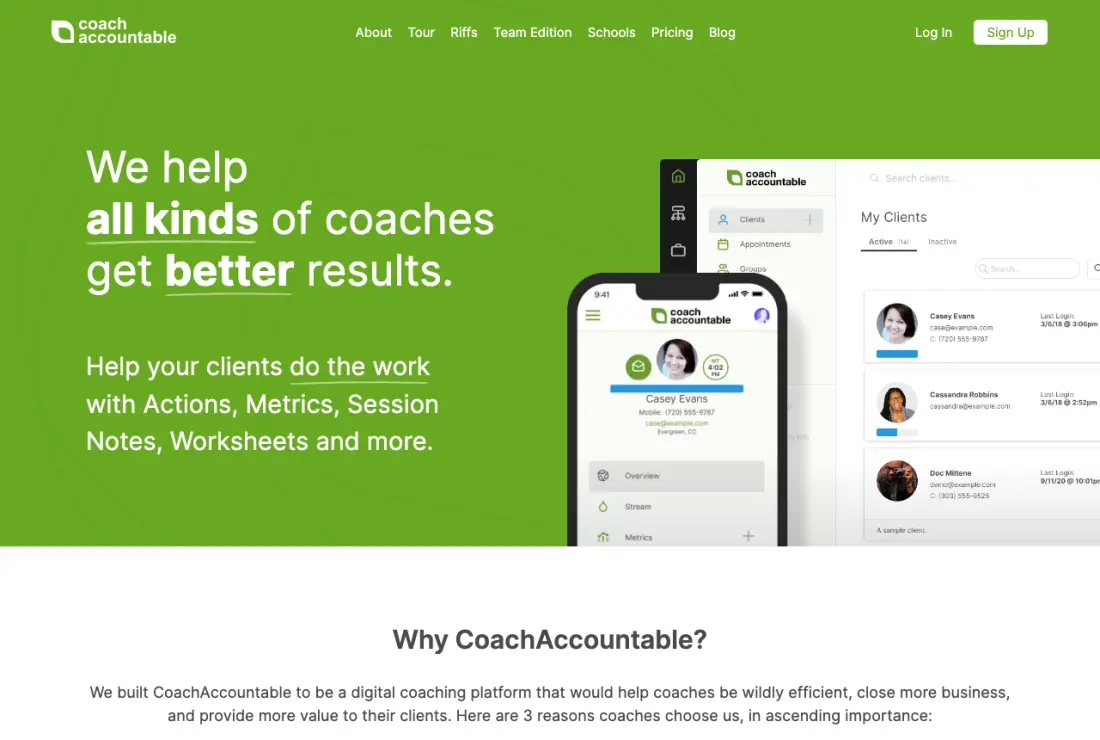
CoachAccountable
$20–100/mo (by client count)
CoachAccountable covers the coaching cluster well — programmes, sessions, progress, actions and metrics — and is better than us at the between-session half of it.
It ships no website and a narrow commerce layer, so the acquisition and marketing parts are elsewhere. From $20, rising with client numbers.
CoachAccountable home page · captured 22–23 September 2026
Best for
Coaches whose method is built on between-session accountability.
Where it falls down
No website, narrow commerce, and pricing that scales with clients.
What this criterion measures, and what it ignores
It measures whether a part of the stack ships with the product. Scheduling, video, payments, contracts, programmes, habits, courses, community, a website, email and a client app. Eleven parts, counted the same way for every product.
It ignores how good each part is. A product that ships a mediocre course builder and a product that ships an excellent one score identically here, which is a real limitation of the criterion and the reason the per-tool notes exist.
It also ignores price. A $179 product covering eight parts ranks above a $29 product covering six, even though the second may be better value. The price list is on every entry so you can make that judgement yourself.
Coverage is counted from the comparison registry rather than judged: a part is shipped, partial or absent, and partial means the product does some of the job rather than all of it.
The eleven parts counted
Scheduling — booking against real availability
Video — sessions inside the product rather than a separate link
Payments — including instalments that collect on a schedule
Contracts — agreements attached to an engagement
Programmes — structured delivery with progress
Habits and check-ins — between-session tracking
Courses — recorded content with access control
Community — a feed or group space
Website — a public marketing site on your own domain
Email — messaging to clients and to a list
Client app — somewhere the engagement lives for the client
The three shapes this list contains
Read the order and a pattern appears that matters more than the ranking itself. The products here cluster into three shapes, and they are not competing with each other so much as with different halves of your stack.
Coaching-shaped products ship programmes, sessions, habits and client records, and frequently no website or marketing layer. CoachAccountable and Simply.Coach are the clearest examples.
Content-shaped products ship courses, checkout, email and pages, and treat coaching as an access grant rather than a relationship. Kajabi is the strongest of these by a distance.
Marketing-shaped products ship funnels, pipelines and automation with no coaching layer at all. GoHighLevel is built for agencies and is unmatched at that job.
A coach assembling a stack is almost always buying one of each, which is how twelve subscriptions happen. Coverage is the criterion that prices that problem.
Photo by Daniil Komov on PexelsEleven parts, counted the same way for every product. Coverage is a count rather than a judgement, which is both its strength and its limit.
Where the count is misleading, and how to correct for it
A coverage count has three blind spots worth naming, because reading this list without them produces bad decisions.
It rewards parts you will never use. A product shipping community, courses and email scores well whether or not any of that is work you would otherwise pay for. Recount the list against the parts you actually need and the order changes for most people.
It treats partial as half a thing. In practice partial coverage is sometimes most of the job and sometimes almost none of it. The registry records the distinction; a count flattens it.
It ignores the cost of breadth. A product covering eleven parts has eleven surfaces to learn, and for a solo coach setup time is real time. Three narrow tools you understand can beat one broad one you have half-configured.
Running this comparison against your own stack
Twenty minutes, and it produces a different answer for almost everyone.
List every subscription you currently pay for, annually
Annual rather than monthly. $25 a month is easy to wave through; $300 a year for a tool you open twice a month is a decision you would reconsider.
Mark which of the eleven parts each one covers
Most coaches find two or three parts covered twice and one covered by nothing, which is where the manual work has been hiding.
Cross out the parts you do not actually use
This is the correction the raw count cannot make for you, and it is the step that changes the ranking most.
Add a realistic figure for coordination
Six to ten hours a week is the documented range for a fragmented stack. At your own rate, that number usually dwarfs the subscriptions.
Compare that total against a consolidated option plus whatever survives
Nothing replaces payment processing, and a dedicated email platform is still better at broadcast. The comparison is totals against totals, not product against product.
The eleven parts, by product
The count behind the ranking, rather than the ranking itself. Partial is the registry’s own term and is never rounded up.
Part
Coachful
Kajabi
GoHighLevel
CoachAccountable
Scheduling
Yes
No
Yes
Yes
Video
Yes
No
No
No
Payments
Yes
Yes
Yes
Yes
Contracts
Yes
Partial
Partial
Partial
Programmes
Yes
Partial
No
Yes
Habits
Yes
No
No
Yes
Courses
Yes
Yes
Partial
Partial
Community
Yes
Yes
Partial
No
Website
Yes
Yes
Yes
No
Email
Partial
Yes
Yes
Partial
Client app
Yes
Portal
No
Portal
Comparison registry, verified May 2026. Coachful is partial on email because a dedicated platform remains better for broadcast newsletters to a large list.
What the fragmented alternative actually costs
The comparison that matters is not one product against another but a consolidated system against the stack it replaces, and the stack has two costs rather than one.
The subscriptions run $539 to $600 a month across roughly twelve tools, or $6,500 to $7,200 a year. That is the number coaches notice, because it appears on statements.
The coordination runs six to ten hours a week: re-entering a client into four systems, reconciling payments against engagements, and hunting information that exists somewhere other than where you are looking. At $150 an hour that is $900 to $1,500 weekly against a software bill of roughly $140.
Any decision made purely on the first number is being made on the smaller of the two by an order of magnitude.
Common questions
What is the best coaching software?
Against a stack-coverage criterion, Coachful, which we make. Against other criteria the answer differs: Kajabi for content, GoHighLevel for marketing automation, CoachAccountable for between-session accountability. The criterion decides the winner, which is why this directory publishes one per list.
How is coverage measured here?
From the same registry as our comparison pages: each of eleven stack parts is recorded as shipped, partial or absent. Partial means the product does some of the job rather than all of it, and it is never rounded up.
Does coverage mean quality?
No, and this is the criterion’s main limitation. A product shipping a weak course builder and one shipping an excellent one count the same. The per-tool notes carry that judgement; the ranking does not.
Why does price not affect this ranking?
Because it is a coverage ranking, and mixing the two would hide what is being measured. Price appears on every entry, and there is a separate list ranked on value.
Is a broad product better than a specialist one?
Only if breadth is what you actually need. A coach using one part of the stack heavily and the rest barely is better served by the specialist. Breadth pays when the alternative is four subscriptions and the coordination between them.
Is it better to have one tool or several specialists?
Several specialists when you use a few parts heavily and the rest barely. One broad tool when you would otherwise be paying for four and joining them together by hand, which is where the six to ten weekly hours go.
What does a fragmented coaching stack actually cost?
$539 to $600 a month across roughly twelve tools, or $6,500 to $7,200 a year, plus the coordination hours. The hours are the larger cost at any reasonable rate and never appear on a statement.
Why is Coachful only partial on email?
Because a dedicated email marketing platform is genuinely better for broadcast newsletters to a large list, and recording ourselves as fully covered would be the kind of rounding-up this criterion exists to avoid.
The verdict
On stack coverage Coachful is first, and we publish this directory. That is a judgement against a stated criterion rather than a claim about quality, and the alternatives below are each better at something we are not.
The more useful reading is the three shapes. Coaching-shaped, content-shaped and marketing-shaped products are solving different problems, and a coach who knows which shape their own business is will pick better from this list than one who reads only the order.
How to disagree with this
The criterion is the whole argument. If breadth is not what you need, this order is irrelevant to you and a different list will serve you better. That is why there are several, each ordered by something different.
For a version of the same products with no ordering at all, the alphabetical directory lists every one of them and picks nothing.
Published by Coachful, which makes one of the products ranked here. No affiliate links and no paid placement.