







Coach Platforms
All rankings

Best scheduling for coaches

What is the best scheduling tool for coaches?

8 min read1,699 wordsChecked 22 September 2026

Scheduling looks like the most commoditised part of a coaching stack and contains the failure that damages a practice fastest: double-booking a client, or worse, appearing for a session the client never saw confirmed.

The criterion here is therefore narrow and technical. Two-way calendar sync, timezone handling that survives daylight saving, and payment attached to the booking rather than chased afterwards.

Those three separate the products far more than the feature lists suggest, and the first one is where most failures come from.

The short answer

Ranked by calendar sync and timezone handling that does not fail, with payment attached, Coachful is first from $29 a month and we make it, with Calendly at $12 to $20 and Acuity at $20 to $61 as the strongest dedicated schedulers. Two-way sync is the feature that actually prevents double bookings.

Best scheduling for coaches
Photo by Matheus Bertelli on Pexels

Ranked by

Calendar sync and timezone handling that does not fail, with payment attached

A double booking or a timezone error costs a client. This is the one job where reliability beats features.

Coachful logoCP 01-001CoachfulCoaching platformfrom $29/mo

Number one

Coachful

coaching platform · from $29/mo

Scheduling tied to the client record, the programme and the payment, so a booking is never an isolated event.

Coachful client workspace, captured 22–23 September 2026
Coachful client workspace · captured 22–23 September 2026
Published monthly price
  • Coachfulfrom $29/mo
  • Calendly$12–20/mo (scheduling only)
  • Acuity Scheduling$20–61/mo (scheduling only)
  • CoachVantage$39–59/mo
  • Satori$33–124/mo (by active clients); free Scholar tier for pro-bono
  • Paperbell$57/mo (per coach)

The full ranking

Pricing verified May 2026

Two through 6

Calendly logoCP 04-012CalendlyScheduling tool$12–20/mo (scheduling only)Acuity Scheduling logoCP 04-023Acuity SchedulingScheduling tool$20–61/mo (scheduling only)CoachVantage logoCP 02-054CoachVantageCoaching admin tool$39–59/moSatori logoCP 02-045SatoriCoaching admin tool$33–124/mo (by active clients); free Scholar tier for pro-bonoPaperbell logoCP 02-016PaperbellCoaching admin tool$57/mo (per coach)

2. Calendly

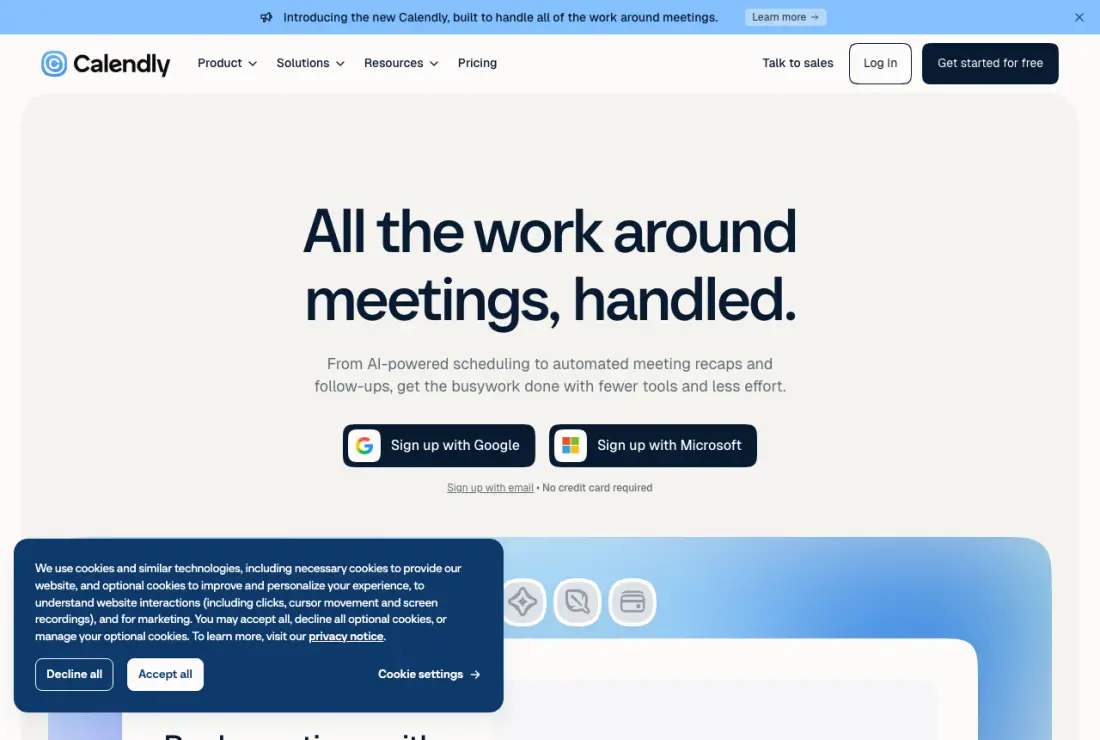
Calendly home page, captured 22–23 September 2026
Calendly home page · captured 22–23 September 2026

3. Acuity Scheduling

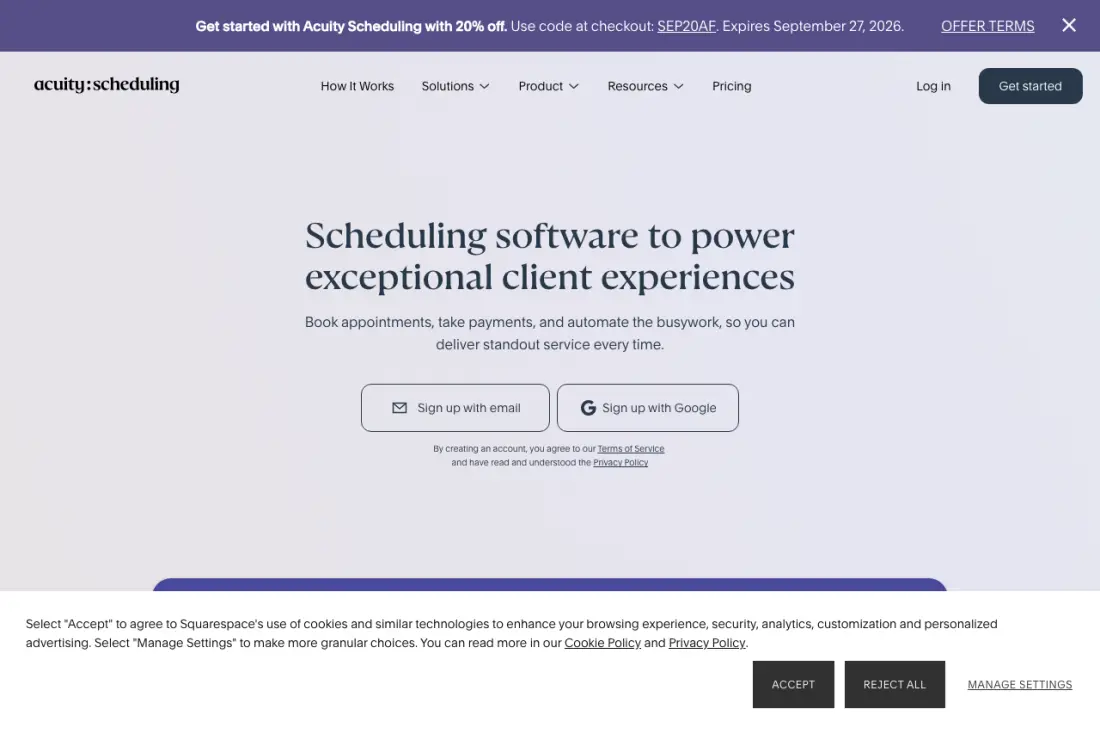
Acuity Scheduling home page, captured 22–23 September 2026
Acuity Scheduling home page · captured 22–23 September 2026

4. CoachVantage

CoachVantage home page, captured 22–23 September 2026
CoachVantage home page · captured 22–23 September 2026

Every tool, in detail

1

Coachful

Coachful handles two-way sync, timezone-aware booking and payment at the point of booking, with the session attached to the engagement it belongs to.

That last part is the difference from a dedicated scheduler: a booking knows which package it is part of and how many sessions remain, rather than being an appointment in a calendar.
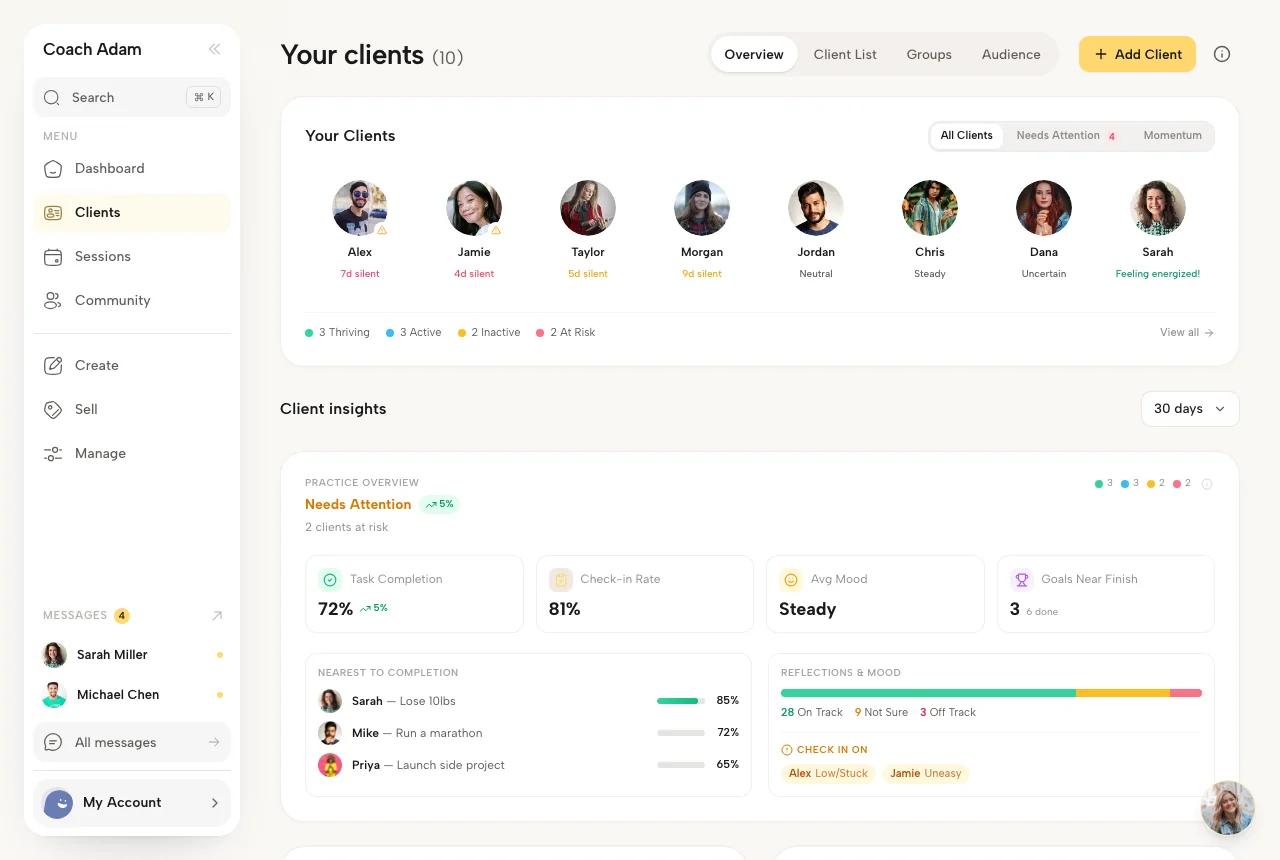
Coachful client workspace, captured 22–23 September 2026
Coachful client workspace · captured 22–23 September 2026

Best for

Coaches whose bookings need to belong to a package rather than float in a calendar.

Where it falls down

Calendly handles timezones better and costs less if booking is all you need.

2

Calendly

Calendly is the strongest pure scheduler here and the registry records its timezone handling as the best in the group, which is what a decade of doing one job produces.

It has no packages or contracts and payment is partial, so everything after the booking is assembled around it manually.

Calendly home page, captured 22–23 September 2026
Calendly home page · captured 22–23 September 2026

Best for

Coaches whose only problem is booking, at the lowest price with the best timezone handling.

Where it falls down

No packages or contracts, and payment sits outside the core flow.

3

Acuity Scheduling

Acuity is the strongest scheduler that also handles packages and payment at booking, with intake forms attached, from $20.

Its packages are prepaid session bundles rather than structured engagements with contracts and renewals, which is a real difference at higher engagement values.

Acuity Scheduling home page, captured 22–23 September 2026
Acuity Scheduling home page · captured 22–23 September 2026

Best for

Coaches selling prepaid session bundles who want payment attached to the booking.

Where it falls down

Packages are prepaid session blocks rather than engagements.

4

CoachVantage

CoachVantage handles booking with contracts and payment attached in a coaching-native product at $39, which covers more than a pure scheduler.

Timezone and sync handling are solid rather than best-in-class, and there is more configuration than a scheduling-only need warrants.

CoachVantage home page, captured 22–23 September 2026
CoachVantage home page · captured 22–23 September 2026

Best for

Coaches who want booking, contracts and payment in one coaching product.

Where it falls down

More configuration than a scheduling-only need requires.

5

Satori

Satori handles enrolment, scheduling and payment with almost no configuration at $33, which suits a coach who wants booking to be invisible.

Contracts are partial and there is no programme layer, so the booking does not belong to a structured engagement.

Satori home page, captured 22–23 September 2026
Satori home page · captured 22–23 September 2026

Best for

Coaches who want scheduling with the least possible setup.

Where it falls down

Partial contracts and no programme structure.

6

Paperbell

Paperbell ties booking to a package and a contract, so a session belongs to something rather than floating in a calendar.

At $57 it is the most expensive option in this group, and scheduling is one of three things it does rather than its focus.

Paperbell home page, captured 22–23 September 2026
Paperbell home page · captured 22–23 September 2026

Best for

Coaches whose bookings should belong to a sold package.

Where it falls down

The most expensive here, with scheduling as one of three jobs.

One-way sync is where double bookings come from

One-way sync writes bookings into your calendar and does not read anything back. Block out a dentist appointment in your personal calendar and the scheduler will happily book a client over it.

Two-way sync reads your existing commitments and removes those times from availability. This is the difference between a scheduler that works and one that produces an apology every few weeks.

Timezone handling is the second failure mode, and it fails asymmetrically: it usually works until a daylight saving change, at which point a small number of clients arrive an hour early or late. Cross-border coaching makes this common rather than rare.

Both of these are checkable in a trial in about ten minutes, and almost nobody checks them.

Sync, timezones and payment

ProductPriceTwo-way syncTimezone handlingPayment at booking
Coachfuloursfrom $29YesYesYes
Calendly$12–$20YesBest herePartial
Acuity$20–$61YesYesYes
CoachVantage$39YesYesYes
Satori$33YesYesYes
Paperbell$57YesYesYes

Comparison registry, verified May 2026. Calendly is recorded as the strongest timezone handling in the group, which is what a decade of doing one job produces.

A coach managing their calendar
Photo by cottonbro studio on Pexels
One-way sync books clients over your existing commitments. It is the most common scheduling failure and the easiest to test for.

The four scheduling failures, in order of damage

Double booking. One-way calendar sync writes into your calendar without reading it, so anything you added elsewhere is invisible and gets booked over. This is the failure that costs you a client rather than an apology.

Timezone drift at a clock change. Usually fine until daylight saving moves, at which point a handful of clients arrive an hour out. Cross-border coaching makes this recurring.

Availability that is not real. A booking page offering slots you would never actually take, which produces either a reschedule or a session you resent.

No buffer. Back-to-back sessions with no gap is how preparation and notes stop happening, and preparation is the line that should not be cut.

All four are testable in a trial in about fifteen minutes, and almost nobody tests any of them before buying.

Fifteen minutes of testing before you commit

  1. Add a blocker to your personal calendar

    Then check whether the booking page removes that slot. If it does not, you have one-way sync and you will double-book eventually.

  2. Change your device timezone and reload the page

    The times shown should follow the visitor, not you. This is where cross-border bookings go wrong.

  3. Book yourself into your own last slot of the day

    Check the confirmation, the calendar entry and the reminder. Read them as a client would.

  4. Set a buffer and confirm it holds

    Fifteen minutes either side, and verify the page will not offer a back-to-back pair anyway.

  5. Cancel and reschedule as the client

    This is the flow you will use most often after the booking itself, and it is the one nobody checks.

The four failures and how to test each one

FailureCauseTestTime
Double bookingOne-way calendar syncAdd a personal blocker, check the page1 min
Client arrives an hour outTimezone handlingChange device timezone, reload2 min
Slots you would never takeAvailability set optimisticallyLook at next week as a client2 min
No preparation timeNo buffers configuredTry to book a back-to-back pair2 min

Seven minutes in a trial covers all four, and they account for nearly every scheduling problem a coaching practice has.

Common questions

What is the best scheduling software for coaches?

Against two-way sync, timezone handling and payment at booking, Coachful from $29 and we make it. Calendly at $12 to $20 has the best timezone handling of anything here, and Acuity at $20 to $61 is the strongest dedicated scheduler with packages.

Why do double bookings happen?

One-way calendar sync. The scheduler writes bookings into your calendar without reading your existing commitments, so anything you added elsewhere is invisible to it and gets booked over.

Is Calendly good enough for a coach?

For booking, yes — it does one job with almost no failure modes and has the best timezone handling here. It has no packages, no contracts and payment is partial, so the engagement is assembled manually around it.

Should payment be taken at booking?

For short engagements and single sessions, always. Consumer coaching closes on a short window of attention, and every manual step between deciding and paying loses a share of buyers who had already decided.

How do I avoid timezone problems?

Test a daylight saving change in a trial before buying. Timezone handling usually works right up until a clock change, and cross-border coaching makes that a recurring problem rather than a rare one.

What causes double bookings?

One-way calendar sync. The scheduler writes bookings into your calendar without reading your existing commitments, so anything added elsewhere is invisible to it. Two-way sync is the fix and it is testable in a minute.

Should I set buffers between coaching sessions?

Yes. Preparation and notes take three to five hours a week and are the one non-billable line worth protecting. Back-to-back scheduling is how that time quietly disappears.

How long should buffers between coaching sessions be?

Fifteen minutes either side is a reasonable default, and longer for heavier work such as relationship or trauma-adjacent coaching where sessions run seventy-five to ninety minutes and cannot reasonably be stacked.

The verdict

Calendly does one job better than anything else here and has the best timezone handling in the group. For a coach whose only problem is booking, $12 a month is the right answer and this list is longer than it needs to be.

Coachful wins the stated criterion because payment at booking and a session that belongs to an engagement are part of it. And whichever you choose, spend ten minutes testing two-way sync and a timezone change, because that is where scheduling actually breaks.

How to disagree with this

The criterion is the whole argument. If breadth is not what you need, this order is irrelevant to you and a different list will serve you better. That is why there are several, each ordered by something different.

For a version of the same products with no ordering at all, the alphabetical directory lists every one of them and picks nothing.

Published by Coachful, which makes one of the products ranked here. No affiliate links and no paid placement.

Other rankings