




Coach Platforms
All rankings

Best for online coaches

What is the best platform for online coaching?

7 min read1,677 wordsChecked 22 September 2026

Almost all coaching is now delivered remotely, which makes "online coaching software" close to meaningless as a category. Every product here works over the internet.

The criterion that still separates them is narrower: can the client do everything inside one place, or do they end up bouncing between a booking link, a video link, an email thread and a payment page?

That matters for a reason that is commercial rather than aesthetic. Every handoff is a place where a client does not arrive, and remote engagements are held together by a lot less than in-person ones.

The short answer

Ranked by whether the whole engagement can be delivered remotely without the client leaving your system, Coachful is first and we make it, followed by Vibly and Kajabi. The deciding feature is in-app video: most products send the client to a Zoom link, which is where the session stops being part of the engagement.

Best for online coaches
Photo by Daniil Komov on Pexels

Ranked by

Delivering the whole engagement remotely without the client leaving your system

Online coaching lives or dies on whether the client can find the session, the notes and the payment in one place.

Coachful logoCP 01-001CoachfulCoaching platformfrom $29/mo

Number one

Coachful

coaching platform · from $29/mo

Video, scheduling, programmes, payments and a client app in one system, so nothing is handed off to a second tool.

Coachful client workspace, captured 22–23 September 2026
Coachful client workspace · captured 22–23 September 2026
Published monthly price
  • Coachfulfrom $29/mo
  • Kajabi$179–499/mo ($143–399 annual)
  • Delenta$29–79/mo (by client-portal cap)
  • Simply.Coach$9–69/mo (by client cap)
  • CoachAccountable$20–100/mo (by client count)

The full ranking

Pricing verified May 2026

Two through 6

Vibly logoCP 01-012ViblyCoaching platformMarketplace fees varyKajabi logoCP 03-013KajabiCourse & marketing platform$179–499/mo ($143–399 annual)Delenta logoCP 01-044DelentaCoaching platform$29–79/mo (by client-portal cap)Simply.Coach logoCP 01-035Simply.CoachCoaching platform$9–69/mo (by client cap)CoCP 02-026CoachAccountableCoaching admin tool$20–100/mo (by client count)

2. Vibly

Vibly home page, captured 22–23 September 2026
Vibly home page · captured 22–23 September 2026

3. Kajabi

Kajabi home page, captured 22–23 September 2026
Kajabi home page · captured 22–23 September 2026

4. Delenta

Delenta home page, captured 22–23 September 2026
Delenta home page · captured 22–23 September 2026

Every tool, in detail

1

Coachful

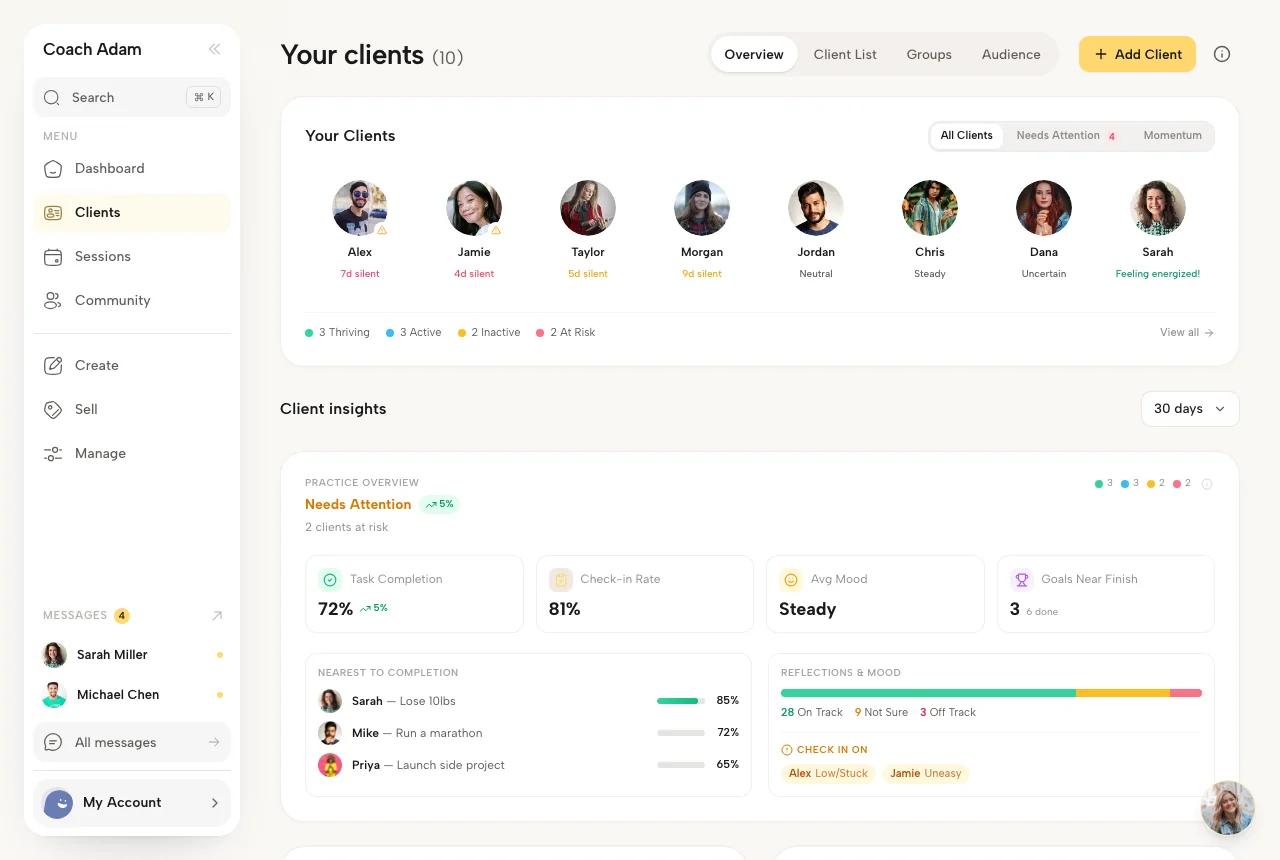
Coachful keeps booking, the session itself, the programme, payments, messages and the client app in one place, which is what the criterion is measuring and what we built for.

The practical difference is that a session opens with the client’s programme and history already attached rather than the coach assembling that context beforehand from three places.
Coachful client workspace, captured 22–23 September 2026
Coachful client workspace · captured 22–23 September 2026

Best for

Remote practices where the engagement should feel like one place rather than five links.

Where it falls down

In-app video is not a full-featured meeting product; Zoom has more controls for large sessions.
2

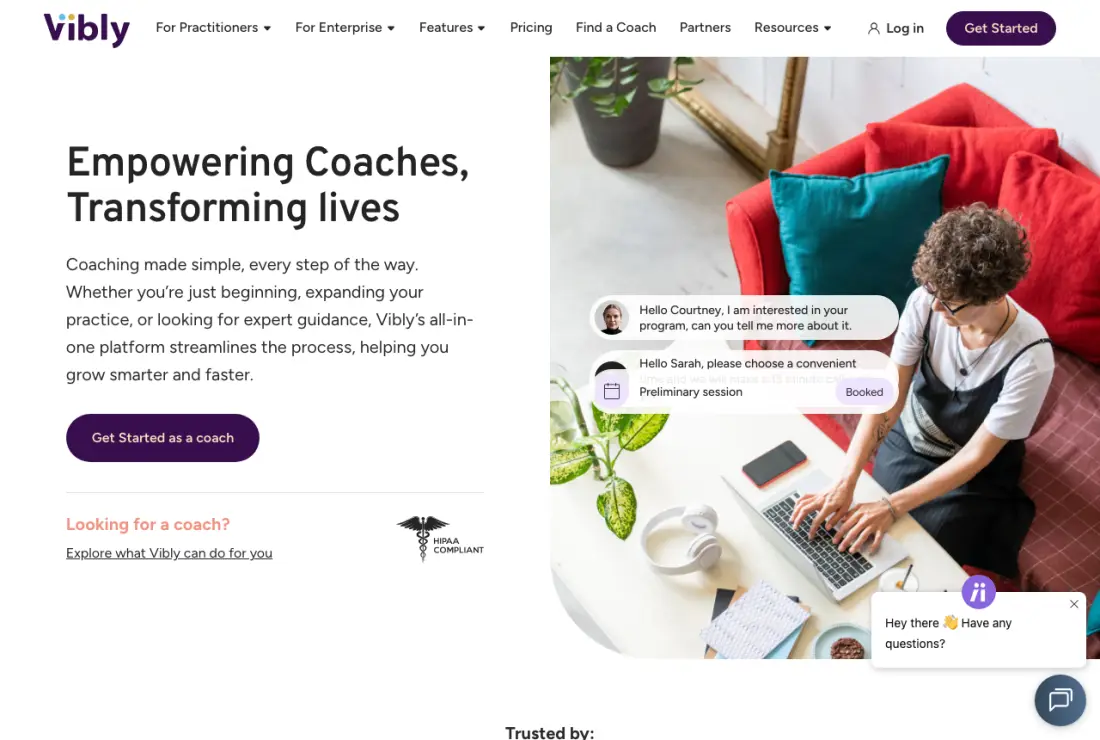
Vibly

Vibly is built for remote coaching specifically and covers the same ground on this criterion: in-app video, a client app and payment in place.

It is the closest direct comparison here on remote delivery, and the narrower product overall — the commerce and content layers are thinner than the top of the broader lists on this site.

Vibly home page, captured 22–23 September 2026
Vibly home page · captured 22–23 September 2026

Best for

Coaches who want a remote-first product and do not need the broader commerce layer.

Where it falls down

Narrower commerce and content layers than the broader products on this site.

3

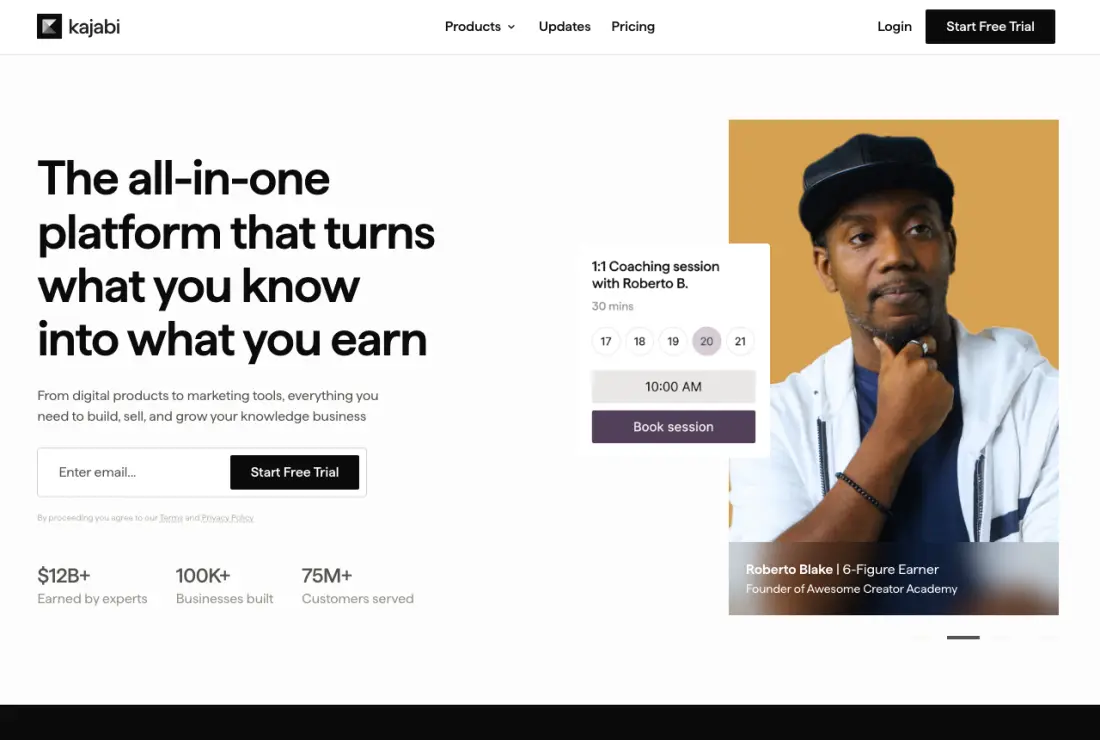
Kajabi

Kajabi gives a remote client an excellent content experience: a portal, courses, a clean checkout and good email.

It has no in-app video and no scheduling, so the live half of remote coaching happens elsewhere. For a content-led online business that is the right trade; for live one-to-one delivery it is two systems.

Kajabi home page, captured 22–23 September 2026
Kajabi home page · captured 22–23 September 2026

Best for

Online businesses selling recorded content, with live coaching as a secondary line.

Where it falls down

No in-app video and no scheduling, so live remote sessions run in a second product.

4

Delenta

Delenta includes in-app video and scheduling at $19, which is unusual at that price and directly relevant to this criterion.

Its commerce layer is narrower, so payment is partial against the standard the top of this list sets.

Delenta home page, captured 22–23 September 2026
Delenta home page · captured 22–23 September 2026

Best for

Remote coaches who want video and scheduling at the lowest price on this page.

Where it falls down

Partial payment handling against the rest of this list.

5

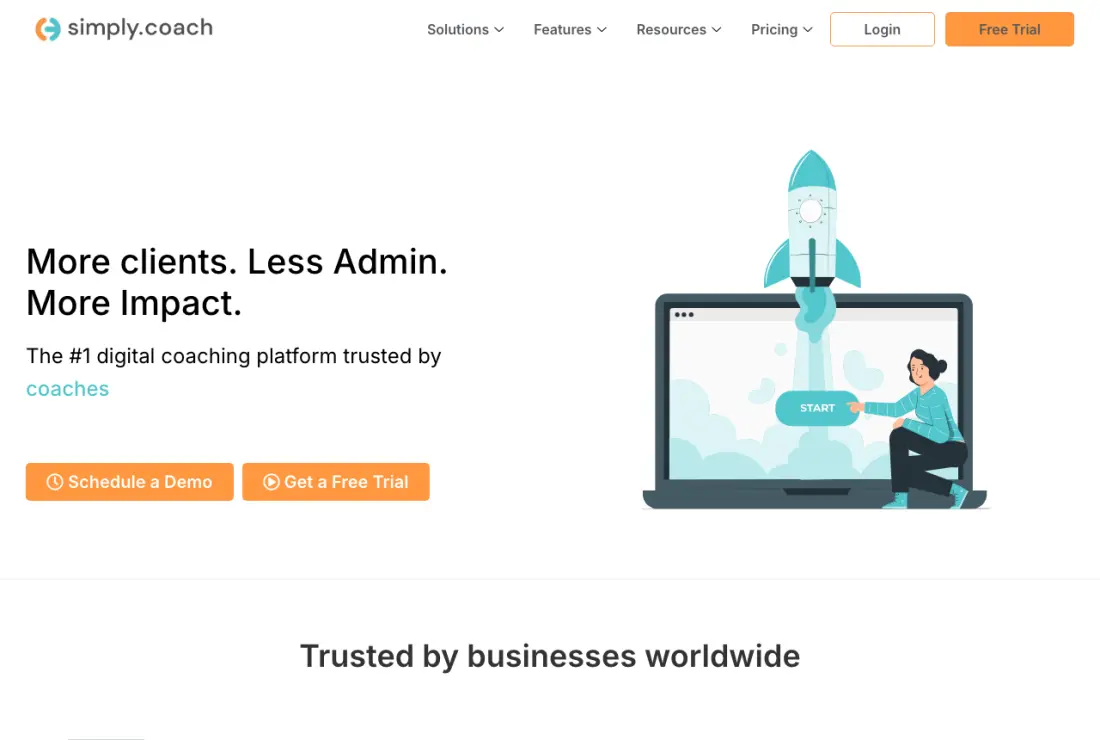
Simply.Coach

Simply.Coach gives a remote client a proper client area with programmes, goals and session records, at $29.

Video is partial, so the live session usually happens in a separate product and the seam this criterion measures remains.

Simply.Coach home page, captured 22–23 September 2026
Simply.Coach home page · captured 22–23 September 2026

Best for

Remote coaches who want a structured client area and already use Zoom.

Where it falls down

Partial video, so the session is a handoff to another product.

6

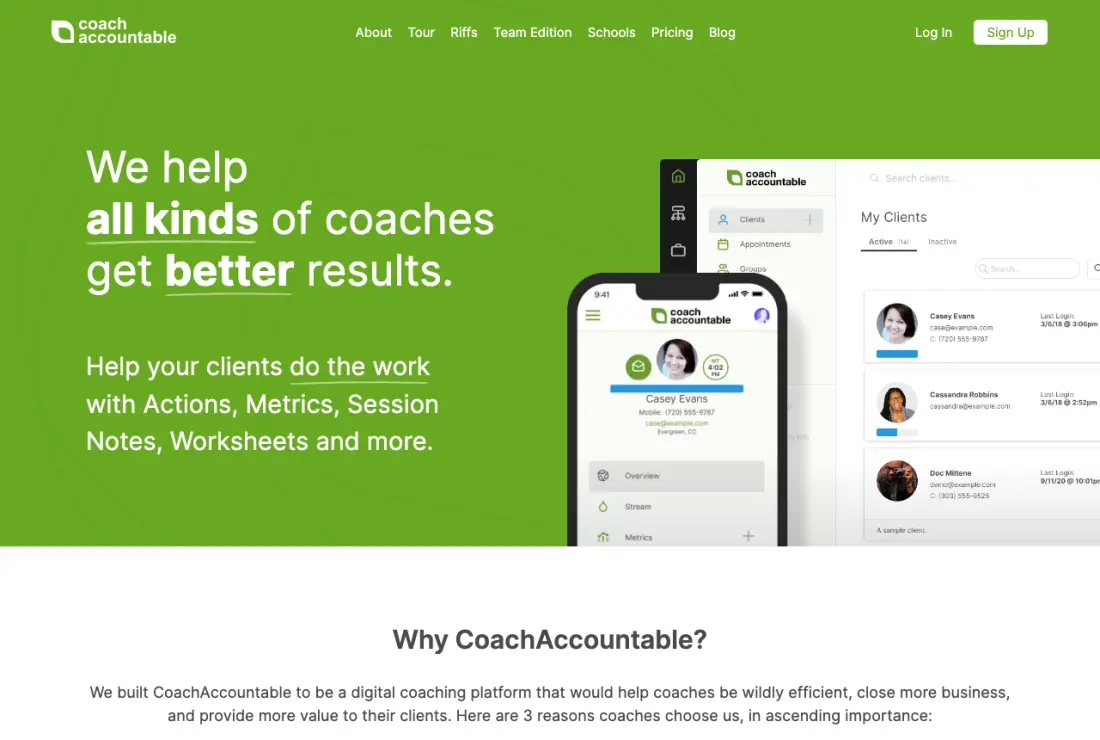
CoachAccountable

CoachAccountable gives a remote client the strongest between-session experience here: actions, metrics and worksheets that make the engagement visible when nobody is in a session.

It has no in-app video, so the session itself is a handoff, and its client surface is a portal rather than a mobile app.

CoachAccountable home page, captured 22–23 September 2026
CoachAccountable home page · captured 22–23 September 2026

Best for

Remote coaches whose between-session work is the substance of the engagement.

Where it falls down

No in-app video, and a portal rather than a phone app.

The handoffs a remote client actually experiences

Map a typical remote engagement and the seams become obvious. A booking link on one domain. A confirmation email with a video link on another.

A payment page somewhere else. Worksheets as email attachments. Messages in whatever channel the coach prefers.

None of those is individually a problem, and collectively they are what makes a remote engagement feel administrative. The client is not experiencing a coaching practice; they are experiencing five products and a coach who keeps sending them links.

In-app video is the single biggest difference on this criterion, because it is where the engagement either lives in one place or does not. A session in a separate meeting product is a session that cannot carry notes, progress or the programme it belongs to.

What the client leaves your system for

ProductPriceIn-app videoClient appPayment in place
Coachfuloursfrom $29YesYesYes
ViblyVariesYesYesYes
Kajabi$179NoPortalYes
Delenta$19YesYesPartial
Simply.Coach$29PartialYesYes
CoachAccountable$20–$100NoYesYes

Comparison registry, verified May 2026. "Portal" means a client-facing area rather than a mobile app.

A remote coaching session on a laptop
Photo by Lukas Blazek on Pexels
Every handoff between products is a place a remote client does not arrive. In-app video removes the largest one.

What remote engagements lose that in-person ones do not

An in-person engagement has a building, a room and a journey. Those are weak forms of commitment and they are not nothing, and remote coaching has none of them.

What replaces them is whatever the client sees between sessions. If that is an inbox and a recurring calendar entry, the engagement exists only during the session itself, and the weeks in between are silent.

That is the real argument for a client app in remote work, and it is why this criterion weights it heavily. Not convenience — presence. A programme the client can see progressing is the remote equivalent of walking into the building.

The handoffs worth removing, in order of cost

  • Payment sent as an invoice after the booking rather than taken at it
  • A video link on a different domain with different branding
  • Documents as email attachments rather than in the client’s own space
  • Messaging in whichever channel the coach prefers rather than one place
  • A booking page that does not show the client’s own timezone

What remote delivery changed

Gap between the highest and lowest regional coaching income bands
0Of that gap explained by how remote coaching is delivered
60–80%Instagram DM opt-in against 20–30% for a link away
1–3 weeksConsumer sale window, which friction closes early

Selling across a border, and what stops it

Remote delivery made geography close to irrelevant to the coaching and left it very relevant to the price, because income tracks the market you sell into rather than the one you live in.

What stops coaches acting on that is almost never demand. It is four operational questions, and three of them are software.

Can a client abroad pay with a normal card in their own currency? If not, nothing else matters. Does your booking page show their time zone or yours? Does your practice read as international or as local? And does a contract exist that works across both jurisdictions?

Most coaches who never cross a border stopped at one of those four rather than at a lack of interest, which makes this criterion commercially larger than it first appears.

Common questions

What is the best software for online coaching?

Against a criterion of delivering the whole engagement without the client leaving your system, Coachful is first and we make it, with Vibly close behind. The deciding feature is in-app video rather than a separate meeting link.

Do I need in-app video, or is Zoom fine?

Zoom works and costs $14.99 a month. What it costs beyond that is context: a session in a separate product cannot carry the client’s programme, notes or history, so the coach carries all of it manually.

Does a client app matter for online coaching?

More than in-person work, because it is the only place the relationship visibly exists between sessions. Without one, the engagement is an email thread and a recurring calendar entry.

Can I run online coaching with free tools?

Yes — a free scheduler, Zoom and a payment link will deliver sessions. The cost is handoffs, and the clients you lose are the ones who did not complete one of them.

Is Kajabi good for online coaching?

For selling online courses, yes, and it is the best here at that. It has no in-app video and no scheduling, so live remote coaching runs alongside it in other products.

Why do remote clients disengage faster?

Because nothing marks the engagement between sessions. In-person work has a building and a journey; remote work has whatever the client can see, and an inbox is not much.

Does timezone handling really matter?

It matters most at daylight saving changes, when a small number of clients arrive an hour early or late. Cross-border coaching turns that from a rare annoyance into a recurring one.

Can I charge international rates from a lower-cost country?

Yes, and a growing number of coaches do. The rate follows the market you sell into. What stops most people is operational — multi-currency payment, time-zone-aware booking, a practice that presents internationally — rather than any resistance from buyers.

The verdict

Every product here delivers coaching remotely. What separates them is how many seams the client experiences, and the largest single seam is video.

If your practice already works and clients happily join a Zoom link, this criterion should not make you change anything. If remote engagements feel administrative and clients drift between sessions, the number of places they have to go is worth counting.

How to disagree with this

The criterion is the whole argument. If breadth is not what you need, this order is irrelevant to you and a different list will serve you better. That is why there are several, each ordered by something different.

For a version of the same products with no ordering at all, the alphabetical directory lists every one of them and picks nothing.

Published by Coachful, which makes one of the products ranked here. No affiliate links and no paid placement.

Other rankings