






Coach Platforms
All rankings

Best for coaching contracts

What is the best way to send coaching contracts?

7 min read1,574 wordsChecked 22 September 2026

Most coaches treat contracts as a legal formality and discover their purpose the first time a client stops attending and asks for a refund.

A coaching agreement prevents exactly two disputes, and they are the two that actually happen: a client who disengages and wants their money back, and one who reschedules indefinitely and expects the sessions to remain available forever.

The criterion here has three parts — signature, storage and the link to the engagement — and the third is the one most products fail, including several that build better contracts than we do.

The short answer

Ranked by signature, storage and the link to the engagement a contract governs, Coachful is first from $29 a month and we make it, with HoneyBook at $36 and Dubsado at $40 both building better contracts. The third requirement is what separates them: a signed PDF in an inbox is not attached to anything.

Best for coaching contracts
Photo by Tima Miroshnichenko on Pexels

Ranked by

Signature, storage and the link to the engagement it governs

A signed contract sitting in an email thread is a contract you will not find when you need it.

Coachful logoCP 01-001CoachfulCoaching platformfrom $29/mo

Number one

Coachful

coaching platform · from $29/mo

Contracts attached to the client and the programme, signed in the same place the work happens.

Coachful client workspace, captured 22–23 September 2026
Coachful client workspace · captured 22–23 September 2026
Published monthly price
  • Coachfulfrom $29/mo
  • HoneyBook$36–129/mo
  • Dubsado$20–40/mo
  • Paperbell$57/mo (per coach)
  • CoachVantage$39–59/mo
  • Satori$33–124/mo (by active clients); free Scholar tier for pro-bono

The full ranking

Pricing verified May 2026

Two through 6

HoneyBook logoCP 05-022HoneyBookClient management & CRM tool$36–129/moDubsado logoCP 05-013DubsadoClient management & CRM tool$20–40/moPaperbell logoCP 02-014PaperbellCoaching admin tool$57/mo (per coach)CoachVantage logoCP 02-055CoachVantageCoaching admin tool$39–59/moSatori logoCP 02-046SatoriCoaching admin tool$33–124/mo (by active clients); free Scholar tier for pro-bono

2. HoneyBook

HoneyBook home page, captured 22–23 September 2026
HoneyBook home page · captured 22–23 September 2026

3. Dubsado

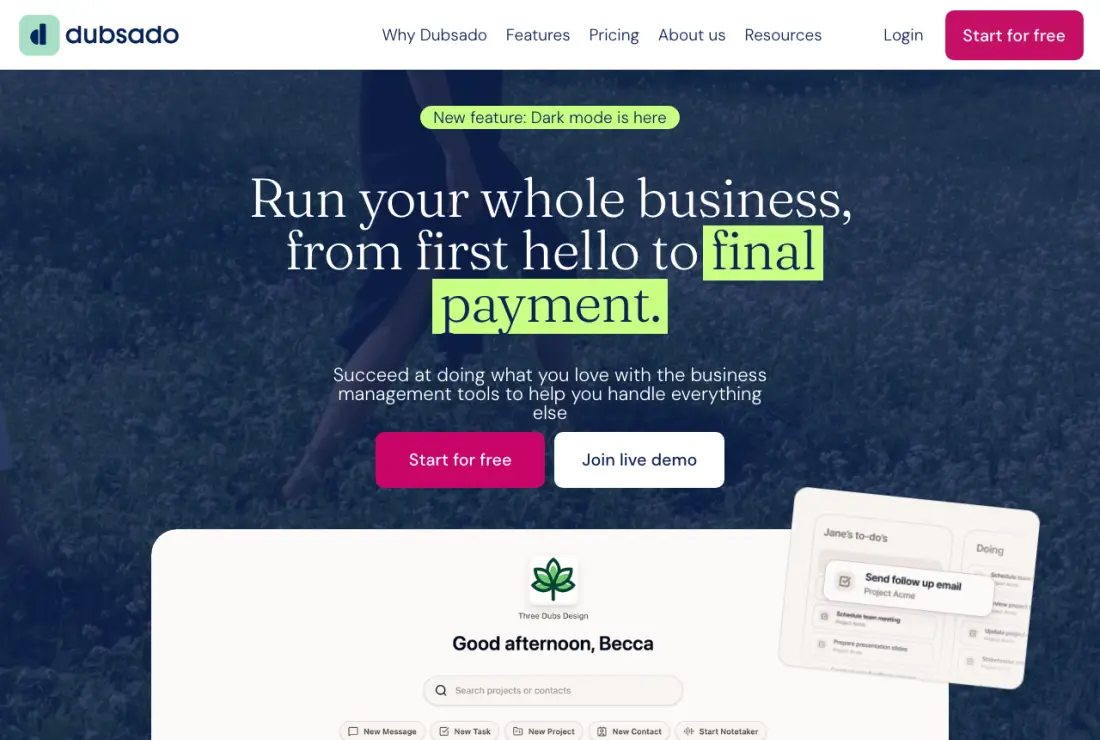
Dubsado home page, captured 22–23 September 2026
Dubsado home page · captured 22–23 September 2026

4. Paperbell

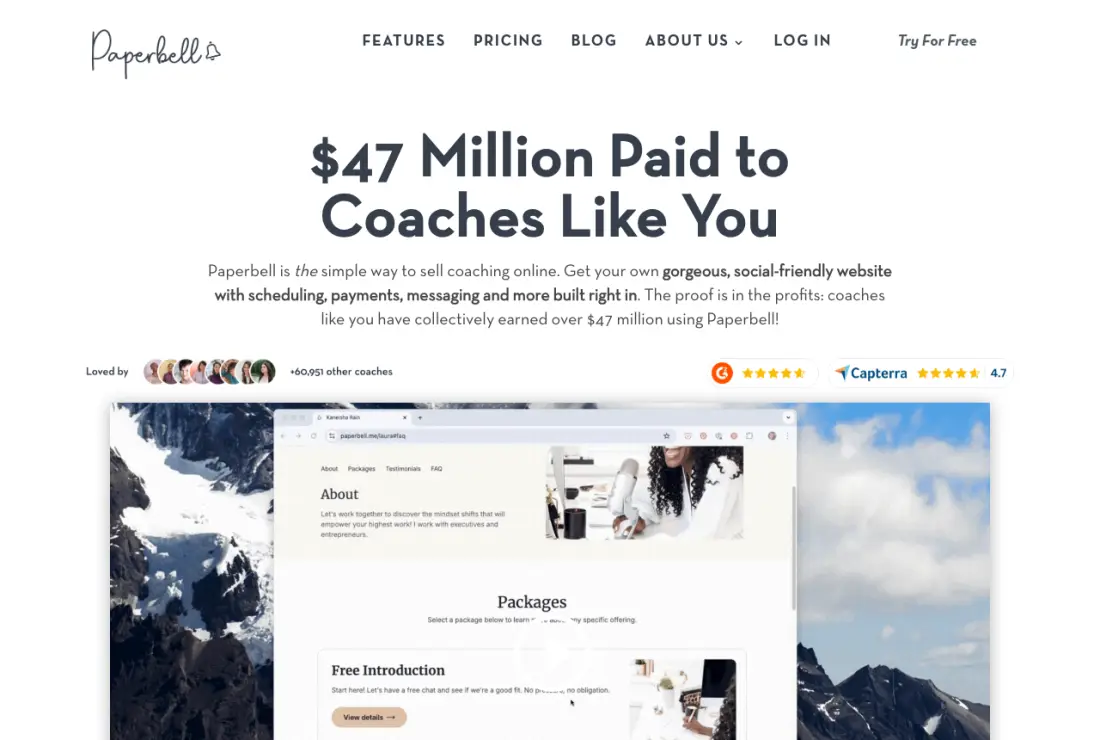
Paperbell home page, captured 22–23 September 2026
Paperbell home page · captured 22–23 September 2026

Every tool, in detail

1

Coachful

Coachful attaches the signed agreement to the engagement, so scope, cancellation terms and payment schedule sit alongside the sessions and the balance they govern.

On contract building alone, HoneyBook and Dubsado are more sophisticated. What Coachful does is make the document findable from the client record at the moment somebody disputes what was agreed.
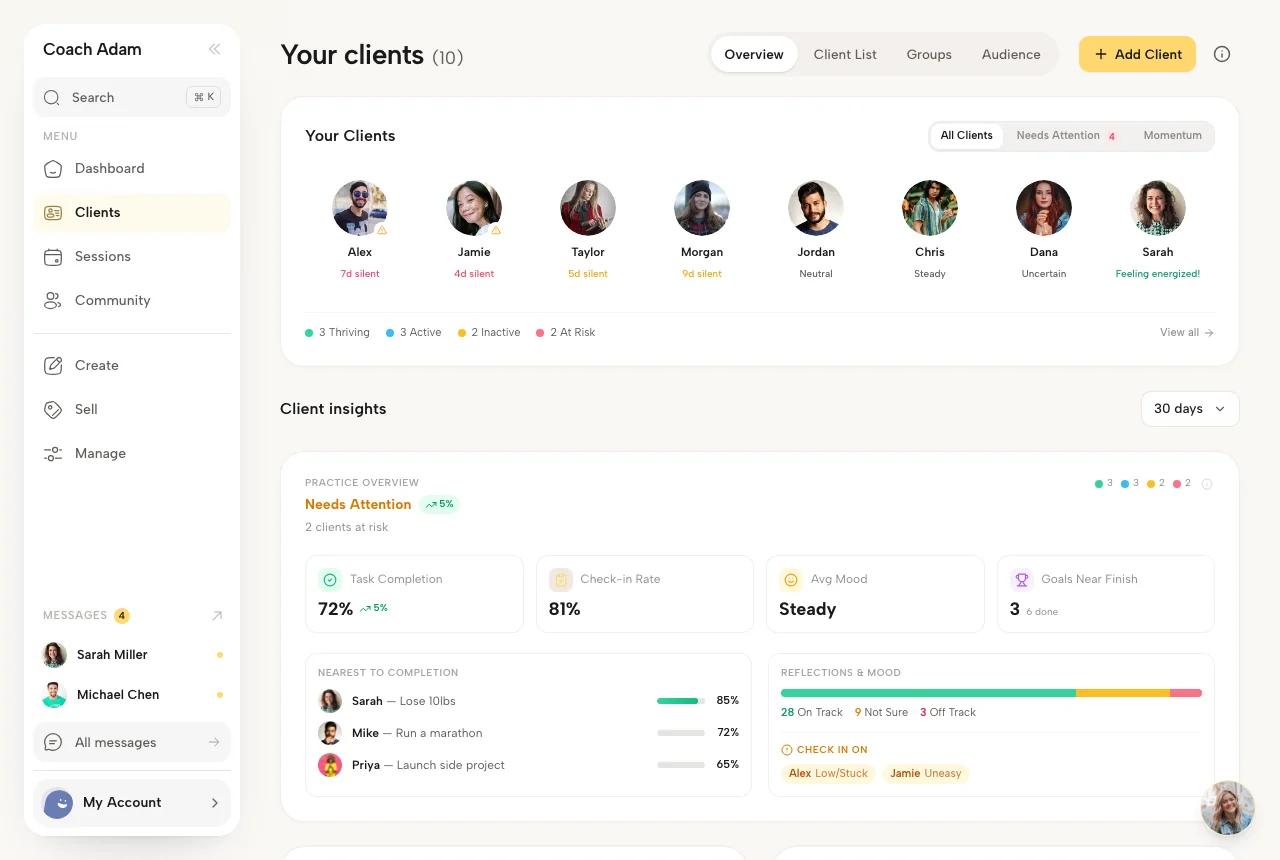
Coachful client workspace, captured 22–23 September 2026
Coachful client workspace · captured 22–23 September 2026

Best for

Coaches who want the agreement one click from the client record it governs.

Where it falls down

HoneyBook and Dubsado both build contracts more deeply than we do.
2

HoneyBook

HoneyBook has the strongest contract and proposal tooling on this page alongside Dubsado, with templates, signature and payment schedules built in.

Agreements attach to a project rather than a coaching engagement, so session counts and renewal dates are not part of what the contract governs.

HoneyBook home page, captured 22–23 September 2026
HoneyBook home page · captured 22–23 September 2026

Best for

Mixed service practices wanting strong contracts across coaching and projects.

Where it falls down

Contracts attach to projects, not coaching engagements.

3

Dubsado

Dubsado matches HoneyBook on contract depth and exceeds it on conditional workflow, which is genuinely useful for multi-stage corporate intake.

The configuration cost is weeks, and like HoneyBook the agreement is tied to a project rather than a coaching engagement.

Dubsado home page, captured 22–23 September 2026
Dubsado home page · captured 22–23 September 2026

Best for

Coaches with complex conditional intake who will invest the setup time.

Where it falls down

Weeks of configuration, and the same project-shaped linkage.

4

Paperbell

Paperbell attaches the contract to the package being sold, so signature happens as part of checkout rather than as a follow-up email.

That sequencing matters more than template depth: an agreement signed at the point of payment is signed, and one emailed afterwards frequently is not.

Paperbell home page, captured 22–23 September 2026
Paperbell home page · captured 22–23 September 2026

Best for

Coaches who want the agreement signed at checkout rather than chased afterwards.

Where it falls down

Template depth below the dedicated CRMs here.

5

CoachVantage

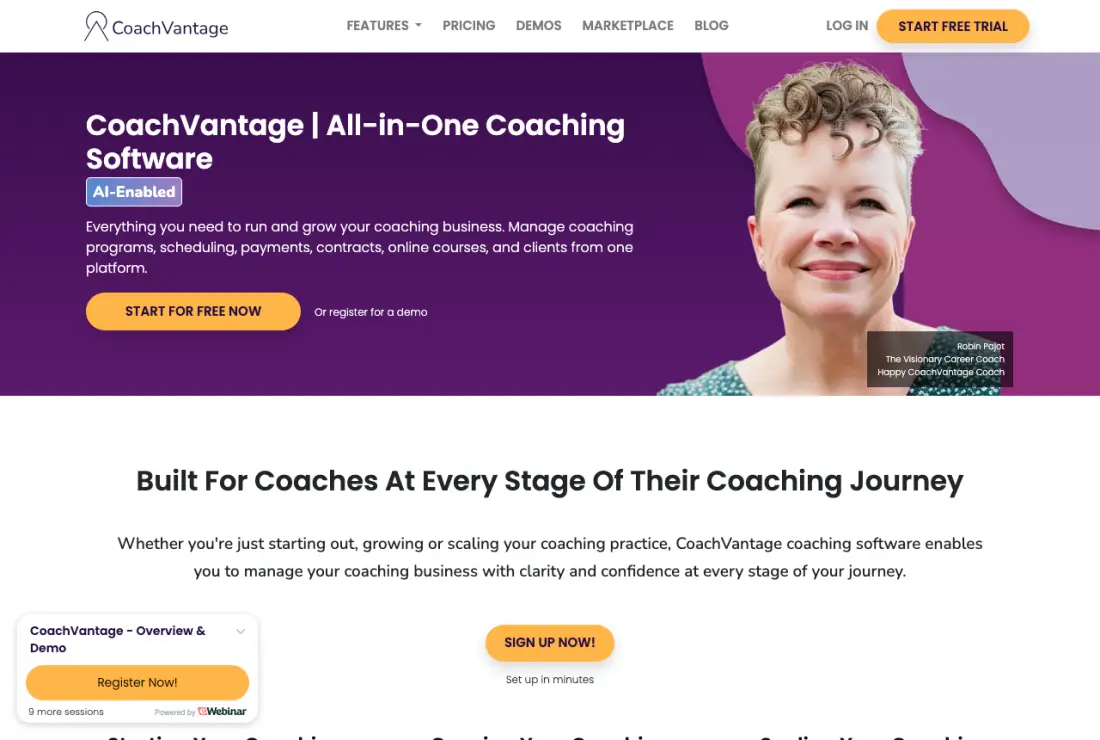
CoachVantage handles contracts properly in a coaching-native product, tied to the client and the engagement at $39.

Template flexibility is below HoneyBook and Dubsado, which is the trade for coaching-specific structure.

CoachVantage home page, captured 22–23 September 2026
CoachVantage home page · captured 22–23 September 2026

Best for

Coaches who want coaching-native contracts tied to the engagement.

Where it falls down

Less template flexibility than HoneyBook or Dubsado.

6

Satori

Satori includes agreement handling as part of a deliberately light enrolment flow, which suits a coach who wants minimal ceremony.

Contracts are partial rather than full, so a corporate engagement or a disputed refund is not well covered.

Satori home page, captured 22–23 September 2026
Satori home page · captured 22–23 September 2026

Best for

Coaches who want minimal ceremony on a small consumer book.

Where it falls down

Partial contracts, which a corporate buyer will notice.

What a coaching contract needs to say

Scope. How many sessions, over what period, with what access between them. Ambiguity here is what produces the "I thought messaging was unlimited" conversation.

Cancellation and rescheduling. How much notice, what happens to a missed session, and whether unused sessions expire. This is the single most useful clause in a coaching agreement.

Payment terms. Amount, schedule, what happens if an instalment fails, and whether the engagement pauses.

Confidentiality, and in corporate work, what is shared with the sponsor. In three-way engagements this is not optional.

None of that is complicated and all of it takes twenty minutes to write once. The failure is almost never the wording; it is that the document was never signed or cannot be found.

Signature, storage and linkage

ProductPriceSignatureStoredLinked to the engagement
Coachfuloursfrom $29YesYesYes
HoneyBook$36Best hereYesTo a project
Dubsado$40Best hereYesTo a project
Paperbell$57YesYesTo a package
CoachVantage$39YesYesTo a client
Satori$33PartialYesPartial

Comparison registry, verified May 2026. A dedicated e-signature tool costs around $25 a month and does the first two columns and none of the third.

A coaching agreement being signed
Photo by energepic.com on Pexels
A coaching contract prevents two disputes: the client who disengages and wants a refund, and the one who reschedules forever.

The two disputes a contract actually prevents

The client who disengages and wants a refund. They booked six sessions, attended two, stopped replying, and three months later ask for their money back. Without a written cancellation and expiry clause this is a negotiation; with one it is a sentence.

The client who reschedules indefinitely. Sessions are moved repeatedly and the engagement never ends, so a six-month package is still open eighteen months later and you cannot count it as revenue or close it out.

Both are common, neither is malicious, and both are prevented by two clauses written once. That is the entire practical case for coaching contracts, and it is more persuasive than the legal one.

The clauses worth twenty minutes

  • Scope: how many sessions, over what period, with what access between them
  • Cancellation: how much notice, and what happens to a missed session
  • Expiry: when unused sessions stop being available
  • Payment: schedule, and what happens if an instalment fails
  • Confidentiality, and in corporate work what is reported to a sponsor

Writing the agreement once, in twenty minutes

  1. State the scope in numbers

    Six sessions of sixty minutes over three months, with weekday messaging answered within 24 hours. Numbers prevent the "I thought it was unlimited" conversation entirely.

  2. Set a cancellation window and a consequence

    24 or 48 hours notice, and what happens to a session cancelled inside it. Vagueness here is what produces the refund dispute.

  3. Add an expiry

    Unused sessions available for three months after the package ends. This is the clause that stops an engagement remaining open eighteen months later.

  4. Describe what happens if a payment fails

    Retry, notification, and whether sessions pause. Deciding this in advance removes the awkward conversation from the moment it happens.

  5. Get it signed before the first session, not after

    An agreement signed at checkout is signed. One emailed afterwards frequently is not, and the one you need is always the one that was not.

Common questions

What is the best coaching software for contracts?

Against signature, storage and linkage to the engagement, Coachful from $29 a month and we make it. HoneyBook at $36 and Dubsado at $40 both build better contracts and attach them to a project rather than a coaching engagement.

Do coaches need contracts?

Yes. A written agreement covering scope, cancellation, rescheduling and payment prevents the two disputes that actually happen, and in corporate work it is a requirement before anything is signed at all.

What should a coaching contract include?

Scope, cancellation and rescheduling terms, payment schedule, and confidentiality — including what is shared with a sponsor in corporate work. It takes about twenty minutes to write once.

Can I just use DocuSign?

It handles signature and storage at around $25 a month. It does not attach the agreement to the engagement, so six months later the document has to be found rather than opened from the client record.

Is a contract necessary for a single session?

Less so, though terms of service covering cancellation and payment still help. The full agreement matters for multi-session packages, where scope and rescheduling are what actually get disputed.

What does a coaching contract prevent?

Two specific disputes: the client who disengages and wants a refund, and the one who reschedules indefinitely so the engagement never closes. Both are prevented by a cancellation and an expiry clause written once.

Does a coaching contract need a lawyer?

For consumer coaching, generally not — scope, cancellation, expiry, payment and confidentiality cover it. Corporate engagements go through legal review on the client side, so a template that survives one is worth having early.

When should a coaching client sign the agreement?

At the point of payment, before the first session. An agreement attached to checkout gets signed; one emailed afterwards often does not, and the contract you end up needing is always one of those.

The verdict

HoneyBook and Dubsado build better contracts than we do, with more sophisticated templates, conditional logic and proposal flows. For a mixed service practice either is a strong choice.

Coachful wins the stated criterion on the third requirement: the agreement is attached to the engagement it governs rather than to a project or an inbox. That difference is invisible until the month it matters, and then it is the only thing that matters.

How to disagree with this

The criterion is the whole argument. If breadth is not what you need, this order is irrelevant to you and a different list will serve you better. That is why there are several, each ordered by something different.

For a version of the same products with no ordering at all, the alphabetical directory lists every one of them and picks nothing.

Published by Coachful, which makes one of the products ranked here. No affiliate links and no paid placement.

Other rankings