







Coach Platforms
All rankings

Best for executive coaches

What is the best software for executive coaches?

8 min read1,703 wordsChecked 22 September 2026

Executive coaching has the highest hourly rate in the profession and the fewest clients. A full book is six to ten people, each on a $10,000 to $50,000 engagement, which inverts what the software has to do.

Most coaching tools are designed to manage volume. Here there is almost none. What there is instead is a small number of very valuable relationships, a corporate buyer with paperwork requirements, and a coach whose time is worth several hundred dollars an hour.

So the criterion is administrative overhead rather than capability. A product that saves an hour a week is worth more here than a product that adds a feature.

The short answer

Ranked by low client volume, high engagement value and minimal administrative overhead, Coachful is first from $29 a month and we make it, with Satori at $33 and CoachVantage at $39 close behind. Executive coaching is six to ten clients paying $10,000 to $50,000, which makes lightness matter more than capability.

Best for executive coaches
Photo by Vlada Karpovich on Pexels

Ranked by

Low client volume, high engagement value, and minimal administrative overhead

An executive coach with ten clients a year needs the paperwork to disappear, not a marketing platform.

Coachful logoCP 01-001CoachfulCoaching platformfrom $29/mo

Number one

Coachful

coaching platform · from $29/mo

Contract, scheduling and session record for a small book of high-value engagements, without marketing machinery in the way.

Coachful client workspace, captured 22–23 September 2026
Coachful client workspace · captured 22–23 September 2026
Published monthly price
  • Coachfulfrom $29/mo
  • Satori$33–124/mo (by active clients); free Scholar tier for pro-bono
  • CoachVantage$39–59/mo
  • CoachAccountable$20–100/mo (by client count)
  • Paperbell$57/mo (per coach)
  • HoneyBook$36–129/mo

The full ranking

Pricing verified May 2026

Two through 6

Satori logoCP 02-042SatoriCoaching admin tool$33–124/mo (by active clients); free Scholar tier for pro-bonoCoachVantage logoCP 02-053CoachVantageCoaching admin tool$39–59/moCoCP 02-024CoachAccountableCoaching admin tool$20–100/mo (by client count)Paperbell logoCP 02-015PaperbellCoaching admin tool$57/mo (per coach)HoneyBook logoCP 05-026HoneyBookClient management & CRM tool$36–129/mo

2. Satori

Satori home page, captured 22–23 September 2026
Satori home page · captured 22–23 September 2026

3. CoachVantage

CoachVantage home page, captured 22–23 September 2026
CoachVantage home page · captured 22–23 September 2026

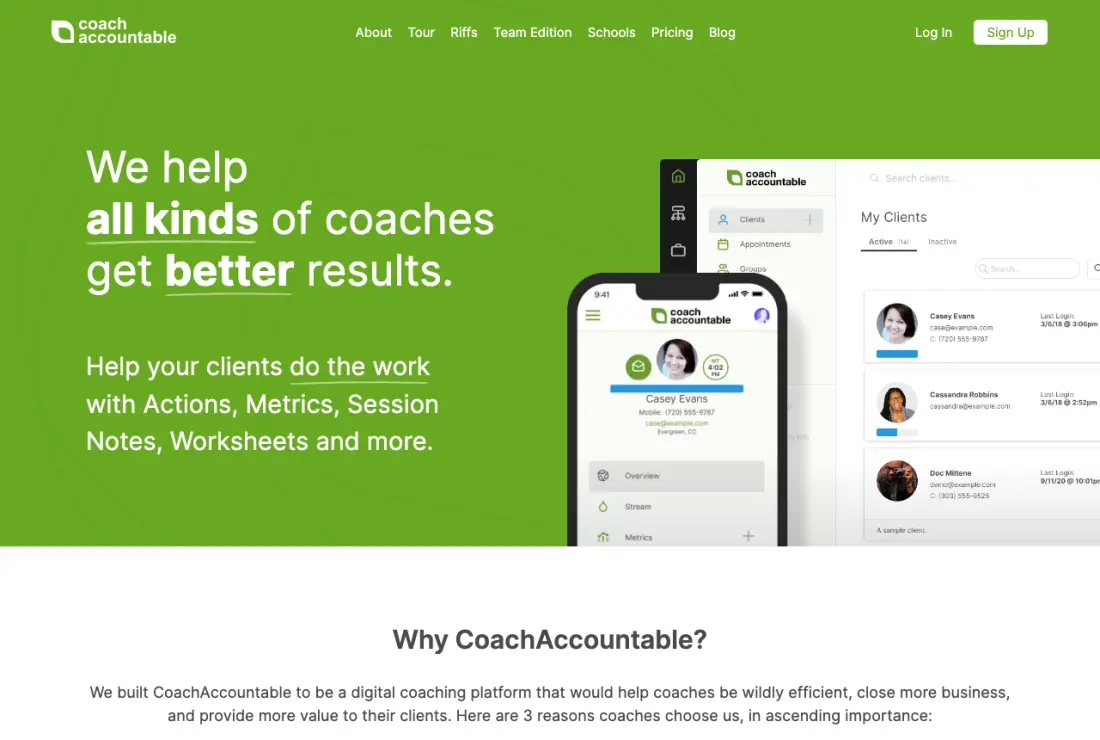
4. CoachAccountable

CoachAccountable home page, captured 22–23 September 2026
CoachAccountable home page · captured 22–23 September 2026

Every tool, in detail

1

Coachful

Coachful covers the corporate requirements — contracts, invoicing, documented session records, a branded surface on your own domain — without demanding the configuration that heavier tools do.

The parts an executive coach does not need are simply unused rather than in the way, which at eight clients is the relevant property.
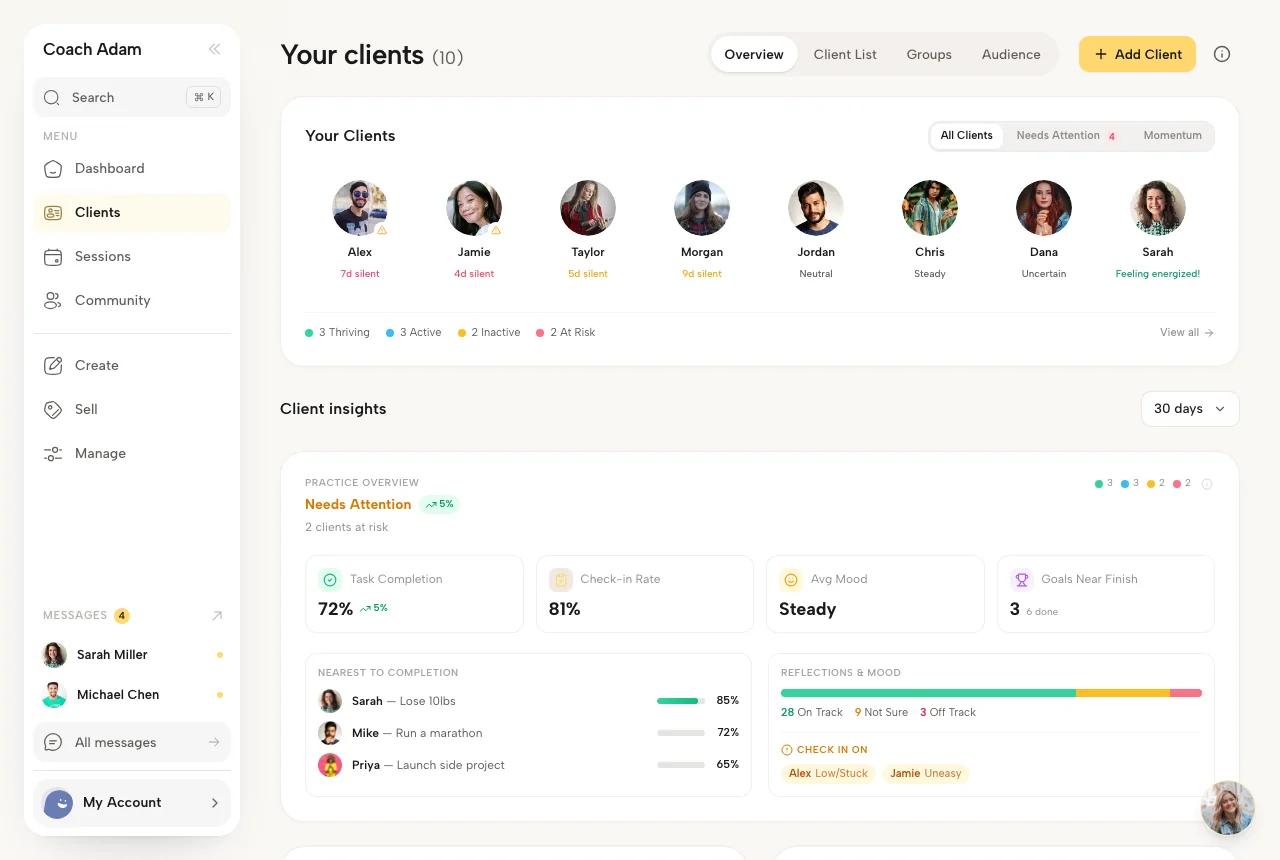
Coachful client workspace, captured 22–23 September 2026
Coachful client workspace · captured 22–23 September 2026

Best for

Executive coaches who need corporate paperwork without a configuration project.

Where it falls down

More product than eight clients strictly require; a lighter tool has less to ignore.

2

Satori

Satori is lighter than anything else here and for a small executive book that is a real advantage: enrolment, scheduling and payment with almost no configuration.

Contracts are partial and documented delivery is light, which is where it stops against a corporate buyer’s requirements.

Satori home page, captured 22–23 September 2026
Satori home page · captured 22–23 September 2026

Best for

Executive coaches with a small book who want the software to disappear.

Where it falls down

Partial contracts and light documentation, which a corporate buyer will notice.

3

CoachVantage

CoachVantage handles contracts and payments properly and is built for coaches, which is the right shape for executive work.

It is lighter on programme structure, which is the part a sponsor wants evidence of when the engagement is reviewed.

CoachVantage home page, captured 22–23 September 2026
CoachVantage home page · captured 22–23 September 2026

Best for

Executive coaches who want coaching-specific contract and payment handling.

Where it falls down

Lighter programme structure, which is what sponsors ask to see.

4

CoachAccountable

CoachAccountable produces the best documented delivery on this page — session records, actions and metrics a sponsor could actually review.

It asks for substantial configuration, which at eight clients is a poor trade, and contracts are partial against a corporate requirement.

CoachAccountable home page, captured 22–23 September 2026
CoachAccountable home page · captured 22–23 September 2026

Best for

Executive coaches whose sponsors want detailed documented delivery.

Where it falls down

Substantial configuration for a book of eight clients.

5

Paperbell

Paperbell handles contracts and payment with almost no setup, which suits a practice that wants the administrative layer to be invisible.

There is no documented delivery of any kind, which is the requirement a corporate sponsor actually has, and at $57 it is the most expensive option here.

Paperbell home page, captured 22–23 September 2026
Paperbell home page · captured 22–23 September 2026

Best for

Executive coaches who want contracts and payment with zero setup.

Where it falls down

No documented delivery, at the highest price in this group.

6

HoneyBook

HoneyBook has the strongest contracts and invoicing in this group, which are two of the four real requirements in executive work.

It has no coaching structure, so documented delivery and session history need a second system — and at eight clients running two systems is most of the overhead this criterion is trying to avoid.

HoneyBook home page, captured 22–23 September 2026
HoneyBook home page · captured 22–23 September 2026

Best for

Executive coaches whose hardest requirement is corporate paperwork.

Where it falls down

No coaching structure, so two systems at eight clients.

What executive coaching actually needs from software

Almost no client management. Eight records is not a data problem. Nothing on this page struggles with eight clients, so the usual comparison points barely apply.

Serious paperwork. The engagement is bought by an organisation. A contract that survives legal review, an invoice that satisfies accounts payable, and evidence of insurance are all requirements rather than niceties.

Documented delivery. A sponsor who never attends a session approved the budget and will review it. A development plan, session records and an assessment are what they point at.

Scheduling that survives chaos. Executive calendars move constantly. Rescheduling has to be trivial or it becomes a weekly administrative task.

Nothing else. Habit tracking, community, courses and funnels are all irrelevant here, and every one of them is a configuration decision you would rather not make.

Overhead against requirement

ProductPriceContractsDocumented deliverySetup cost
Coachfuloursfrom $29YesYesAn afternoon
Satori$33PartialLightMinimal
CoachVantage$39YesLighterModerate
CoachAccountable$20–$100PartialYesSubstantial
Paperbell$57YesNoUnder an hour
HoneyBook$36Best hereNoModerate

Comparison registry, verified May 2026. Setup cost is the coach’s own time before the product is usable.

An executive coaching conversation
Photo by Mikhail Nilov on Pexels
Six to ten clients at $10,000 to $50,000 each. Volume is not the problem; paperwork and rescheduling are.

The administrative load that actually exists at eight clients

It is not client management. Eight records is nothing, and every product on this page handles it. The load comes from four places and they are all unglamorous.

Rescheduling. Executive calendars move constantly. A reschedule that takes three messages and a manual calendar update, happening twice a week, is a weekly administrative job.

Invoicing against purchase orders. Corporate finance departments have processes, and an invoice that does not match one comes back.

Documented delivery for a sponsor. A development plan and session records that somebody who never attends can review, produced during the engagement rather than reconstructed at the end.

Three-way contracting. Coach, coachee and sponsor, with an explicit agreement about what is shared. This is unpaid work and it happens before the engagement starts.

What executive coaching needs and does not

Genuinely required

  • Contracts that survive a legal review
  • Invoicing that satisfies accounts payable
  • Documented session records a sponsor can read
  • Rescheduling that costs seconds rather than messages
  • A surface that does not embarrass a senior client

Irrelevant at this scale

  • Habit tracking and daily check-ins
  • Community and cohorts
  • Course hosting
  • Funnels, landing pages and email sequences
  • Anything that scales client volume

What a sponsor is actually reviewing

The person who approved a $20,000 engagement will never attend a session, and at some point they will ask whether it worked. What they have to go on is whatever was documented while it ran.

A development plan agreed at the start, naming what the engagement is for in terms the organisation recognises.

A record that sessions happened, with dates. Not content — confidentiality makes that inappropriate — but evidence of delivery.

An assessment at each end, frequently a 360 or a psychometric, which is what makes a change legible to somebody outside the room.

A closing summary written for the sponsor rather than the coachee, respecting what was agreed to be shared.

None of that is coaching and all of it decides renewal, which is why documented delivery sits in this criterion at all.

Common questions

What is the best software for executive coaches?

Against low volume, high value and minimal overhead, Coachful from $29 a month and we make it. Satori at $33 is lighter still, and HoneyBook at $36 has stronger contracts with no coaching structure.

Does an executive coach need much software?

Less than most coaches. Eight clients is not a data problem. What is required is paperwork that survives procurement, documented delivery for a sponsor, and rescheduling that does not become a weekly task.

How much is an executive coaching engagement worth?

$10,000 to $50,000 for a six-month to annual contract, with hourly rates of $200 to $500 and around $1,500 at the very top of the board-level market.

Why does documented delivery matter?

Because the person who approved the budget rarely attends a session. A development plan, session records and start-and-end assessments are what they review, and engagements without them are harder to renew.

Should executive coaches use a corporate tool like HoneyBook?

It is stronger on contracts and invoicing and has no coaching structure, so documented delivery and session history need a second system. For a coach whose work is purely executive, that split is frequently acceptable.

How many clients does an executive coach have?

Six to ten in a full book. The rate is $200 to $500 an hour and around $1,500 at board level, but the calendar is constantly disrupted by travel and reorganisations, which caps volume rather than price.

What administration does executive coaching actually create?

Rescheduling, invoicing against purchase orders, documented delivery for a sponsor, and three-way contracting. None of it is client management, which is what most coaching software is designed to solve.

What should an executive coach report to a sponsor?

Whatever was agreed in three-way contracting before the engagement started — typically that sessions happened, progress against the development plan, and a closing summary. Session content stays confidential unless the coachee explicitly agreed otherwise.

The verdict

This is the one list on the site where less product is closer to the right answer. Satori is lighter than we are and that is a genuine advantage at eight clients.

Coachful wins the combined criterion because executive work still needs the corporate half — contracts, invoicing, documented delivery on your own domain — and getting that from a light tool means a second subscription. At a $20,000 engagement value the deciding question is not price; it is whether procurement is satisfied and whether rescheduling is free.

How to disagree with this

The criterion is the whole argument. If breadth is not what you need, this order is irrelevant to you and a different list will serve you better. That is why there are several, each ordered by something different.

For a version of the same products with no ordering at all, the alphabetical directory lists every one of them and picks nothing.

Published by Coachful, which makes one of the products ranked here. No affiliate links and no paid placement.

Other rankings